

Introduction
Recently, I interviewed Maneka Gandhi about her work on animal welfare and protection in India. She spontaneously told me of her telling the 14th Dalai Lama to stop “boasting” to everyone about eating meat for health reasons, and that at her request he stopped eating meat but then later he reverted back to eating animals, according to the advice of his Tibetan doctor. She contrasted this with the “angel-from God” influence of the 17th Karmapa in India in terms of animal welfare and vegetarian diet.
Also, in a previous podcast, the renowned author and Animal Rights philosopher Peter Singer told me that he found it “absurd” that the 14th Dalai Lama continues to eat meat. Singer asserted that as a major global advocate for compassion, the Dalai Lama should not eat meat when healthy plant-based foods and protein alternatives are readily available. Singer is a famous ethics professor and author of the book Animal Liberation. Singer believes we should avoid causing suffering to all living things. He argues that since humans do not need meat to survive, eating it is wrong.
Moreover, as I wrote about in my article (2024) here Buddhist Teachings on Eating Slaughtered Animals (Buddhist Door Global) in the Mahayana Sutras, the Buddha gave many teachings stating that a Bodhisattva on the path should not eat slaughtered sentient beings in any situation. In the Vinaya Sutras, the Buddha gave the example of the three-fold purity rule, the only exception via which a monk could eat meat if they were 100 percent sure the animal had not been deliberately killed to eat, and had died a natural death not brought about by deliberate killing.
So what should we make of the fact that the 14th Dalai Lama (and many other Buddhist monastics who follow him) has publicly stated that he eats meat for his health. And that he tried to be vegetarian in the past but his doctor blamed it for causing him major health problems. Yet, despite his personal diet, the Dalai Lama encourages others to eat less meat and has urged people to adopt plant-based diets. As the 17th Karmapa recently taught, we cannot cetagorically say that great Buddhist masters who eat animals lack compassion, however, we can say that the ordinary Buddhists who follow them are not in the same league as these masters in benefiting murdered animals, and so we should follow the Buddha’s clear teachings and avoid it. In addition, we do not need religious scriptures to know if eating animals is permitted or not, like a child when seeing an animal killed, we can see it is wrong and would be crying if we had to do it.
In sum, the answer is eating animals, even for health reasons, was not permitted by the Buddha for the monastic sangha in ancient times, other than in very strict (extreme) circumstances; none of which would apply to most people in the 21st Century anyway. This article considers some of the main reasons why it is not permitted and why it is indeed ‘absurd’ (and also outdated science) that a doctor advised the Dalai Lama to do so.
Music? NoBody is a Product by Adele Tomlin/Dakini Songs and Meat is Murder by the Smiths.
Dedicated to the millions of suffering and tortured animals in slaughterhouses worldwide voiceless, afraid, tortured and cruelly slaughtered every day by humans for a quick half hour meal, three times per day. May they experience happiness, peace and joy free from suffering.
Do the original Buddhist Vinaya rules allow monastics to request and eat meat for health reasons?
In the Patimokkha (the core rules of the Vinaya), the Buddha explicitly stated that monastics can only accept meat offered to them in the context of begging for alms, but even then monastics can only be permitted to eat it meat as long as they were 100 percent sure it was “triply pure” (not seen, heard, or suspected to be killed specifically for food).
In addition, Buddha explicitly listed butchery and hunting animals as wrong livelihoods, along with selling of weapons, poison, drugs/intoxicants, and humans.
Modern mass factory farming violates the spirit and the technical requirements of the original Vinaya’s threefold purity rule

While the rule was originally designed in ancient India for individual monks receiving random leftovers on alms rounds, applying it to modern industrial meat production creates a massive ethical and logical contradiction.
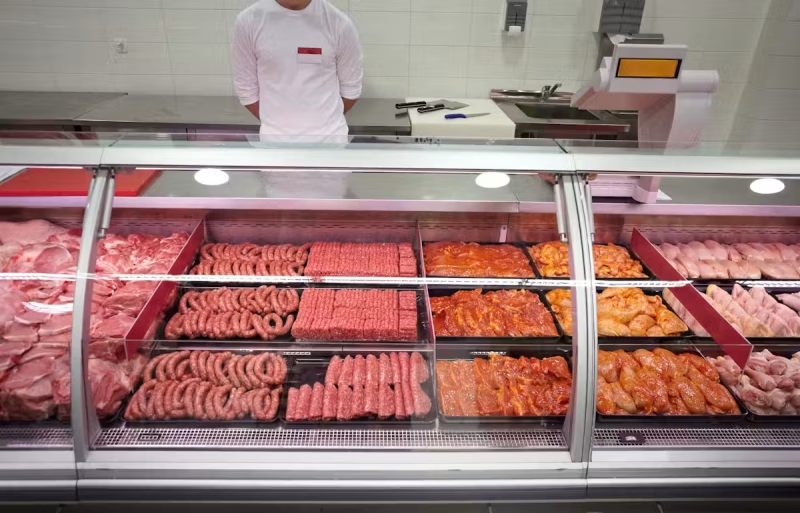
- The “Not Suspected” Violation: The third clause of the rule states that meat is impure if a monk suspects the animal was killed specifically for them. In the global capitalist system of factory farming, the entire industry is driven directly by consumer demand. Every time meat is purchased from a store or market, it finances the slaughter of the next animal. Therefore, any consumer—including a monastic—is directly part of the economic chain causing the killing. It is impossible not to suspect that animals are being systematically slaughtered for the collective market of meat-eaters.
- Active Sponsorship: Great masters like Chatral Rinpoche and the 17th Gyalwang Karmapa have argued that buying meat from factory farms is legally and karmically equivalent to hiring a butcher. By paying for the final product, the consumer explicitly sponsors the operation of the slaughterhouse.
- Systemic Cruelty vs. Accidental Leftovers: The Buddha allowed meat only because ancient laypeople were offering whatever scraps they happened to have cooked for their own families. In contrast, factory farming is a deliberate, highly organized system of mass confinement, torture, and slaughter. Consuming meat from this system means a monastic is actively participating in a massive web of violence, which directly violates the primary Buddhist vow of Ahimsa (non-harming).
Because factory farming inherently breaches the threefold rule, modern Buddhist leaders and scholars argue that the “threefold purity” loophole no longer exists in the modern world.
The 17th Karmapa explicitly stated that because of how the modern meat industry works, eating meat today directly damages Great Compassion and cannot be justified by ancient rules meant for a completely different economic and social reality.
Scholarly Arguments: Capitalism and Threefold Purity
-
- The Predictive Demand Loop: Under free-market capitalism, grocery stores and monasteries use automated inventory systems. Every time meat is purchased, a data point is logged. This data directly dictates how many animals the store will order from the slaughterhouse next week. Animals rights and vegan advocates argue that you can no longer say an animal was “not killed for you” when your specific purchase directly triggers the breeding and slaughter of its replacement.
- The “Joint Action” Principle: Philosophers applying Buddhist ethics to modern systems use the concept of joint action. Even if a monk does not see the butcher, the monk and the butcher are acting as a single economic unit. The butcher provides the labour, and the consumer provides the capital. Without the consumer’s capital, the butcher cannot legally or physically continue to kill. Therefore, the consumer shares direct karmic responsibility for the act of slaughter.
- The Redefinition of “Suspected”: Scholars argue that in the 21st century, “suspicion” must expand from an individual to a system. A monastic knows with 100% certainty that factory farms exist solely to supply meat to paying customers. Because a monastic’s kitchen buys this meat using institutional funds, they must suspect—and indeed know—that animals are being systematically tortured and killed to fulfill their specific supply chain.
The Context of the Dalai Lama’s Choice to Eat Meat for Health reasons

If the Buddhist Sutras and modern medical advice clearly shows that meat isn’t necessary or required for health reasons, why did the 14th Dalai Lama’s doctor prescribe it?
The Illness Exception: Under normal circumstances, a monk is strictly forbidden from asking or receiving from laypeople specific, high-quality foods such as butter, sugar, meat, milk and others. However, Pacittiya Rule 39 explicitly states that if a monk is unwell or sick, an exception can be made.
Because the Dalai Lama follows the Mulasarvastivada Vinaya (the Tibetan monastic lineage), when his doctors ordered him to resume eating meat for health reasons, his followers argued he was acting fully within the allowable medical exceptions of his monastic vows.
However, the decision was largely a product of historical and cultural limitations rather than modern nutritional science:
- The 1960s Medical Landscape: When the Dalai Lama fell ill in 1960s India, modern plant-based nutritional science (such as understanding B12, amino acid profiling, and targeted plant-based liver diets) was not widely understood or available.
- Traditional Medicine Bias: His personal physicians were trained in traditional Tibetan medicine, which heavily relies on meat broths as a vital “heating” energy source to restore physical strength in a cold climate.
Ultimately, the Dalai Lama’s continued consumption of meat is a result of a 1960s medical directive based on outdated dietary understanding. Today, any patient with the same condition could easily and safely recover on a strictly vegan or vegetarian diet. From a modern nutritional and medical perspective, —the argument that one must eat meat to be healthy is obsolete. Modern dietary science show that a heavily meat-based diet can actually place more stress on a body as it is full of toxins and chemical and antibiotics. The medical consensus reveals why the “meat for health” argument does not hold up today .
The Major Health Risks to the Planet and Humans from Eating Meat

Aside from the cruelty to animals, and massive destruction and waste of natural resources and the environment that is literally killing the planet, there is a massive and growing body of modern medical research explicitly states that eating meat—especially red and processed meat—is detrimental to long-term human health.
Renowned Buddhist Masters Who Refused Meat for Health Reasons, even during Illness

Moreover, even if people are permitted to eat (non-slaughtered) animals for severe sickness or starvation, there are still many great examples of Buddhist masters (long before the mass factory farming and sophisticated modern scientific dietary analyses of the 21st Century) who refrained from eating it even in such difficult circumstances. I interviewed US scholar, Dr. Geoffrey Barstow, about this topic in 2023, see here. In his books and research, Barstow translates and highlights the important tradition of abandoning eating animals, in Tibet for centuries pre-1959.
Historical examples in Tibetan Buddhism:
- Lord Jigten Sumgön (1143–1217)
The revered founder of the Drigung Kagyu tradition, Jigten Sumgön, was one of Tibet’s most passionate historical advocates for strict vegetarianism.
- The Incident: When he became gravely ill, his attendants, students, and physicians begged him to drink meat broth to restore his physical strength.
- The Refusal: He steadfastly refused to touch even a single drop of broth flavored with meat or animal fat. He famously warned his disciples that if they ate meat, they were violating the core compassionate teachings of the lineage.
These examples prove that strict, uncompromising vegetarianism—even during illness—is a deeply rooted, highly respected tradition across multiple schools of Tibetan Buddhism.
2. Kunkhyen Dolpopa Sherab Gyaltsen (1292–1361)

The great founder of the Jonang tradition, Dolpopa, was a fierce and uncompromising advocate for animal rights and vegetarianism.
- The Vow: Dolpopa took full monastic ordination at age 22 and swore off meat completely for the rest of his life.
- The Stance: His writings are prominently featured in historical compilations regarding the faults of eating meat. He explicitly argued that the Mahayana Bodhisattva vows completely override any permissive clauses or loopholes found in the Vinaya. Even when facing physical ailments later in life, he refused to consume meat or animal broths, viewing the protection of sentient life as an absolute, non-negotiable spiritual duty.
3. Ngorchen Künga Zangpo (1382–1456)

A massive figure in the Sakya tradition, he founded Ngor Monastery and established the Ngor sub-school.
- The Stance: Ngorchen wrote the famous Epistle Benefitting Students, a fierce text explicitly condemning the consumption of meat and alcohol by monastics.
- The Refusal: Like Jigten Sumgön, when he faced physical sickness, he actively rejected standard Tibetan medical advice to take meat-infused broths. He argued that keeping monastic conduct completely pure was far more vital than keeping the temporary physical body alive.
These historical examples perfectly illustrate the point you have been making throughout this conversation: while the technical text of the Vinaya allows a legal loophole for illness, the highest Mahayana spiritual ideal for these great masters was to refuse meat entirely, no matter the physical cost.
4. The Karmapas, Karma Kagyu Lineage & The Great Encampment

The Karma Kagyu tradition has perhaps the longest-running institutional history of enforcing strict vegetarianism in Tibet, long before modern times. Multiple Karmapas rejected meat entirely and expected their monks to do the same:
- The 4th Karmapa, Rolpe Dorje (1340–1383): He was a staunch vegetarian who actively avoided meat throughout his life.
- The 8th Karmapa, Mikyö Dorje (1507–1554): He famously instituted the Rules of Tsurphu Monastery. He banned meat entirely from the Great Encampment (Garchen), strongly criticizing the excuse that monastics needed meat for health or ritual purposes.
- The 10th Karmapa, Chöying Dorje (1604–1674): He and his closest disciples maintained a strict vegetarian lifestyle. It is recorded that no meat was ever allowed to even be brought into his sight.
Contemporary examples of masters who refused meat, even when very sick:

- Venerable Master Chin Kung (1927–2022): A world-renowned Pure Land master who was a strict vegetarian for over 70 years. Throughout his life and final years, despite facing severe age-related illnesses, he steadfastly refused any medical suggestions to consume meat broth or animal derivatives, relying entirely on plant-based nutrition and spiritual practice until his peaceful passing.
- Venerable Master Xuan Hua (1918–1995): The founder of the City of Ten Thousand Buddhas in the United States. He established a monastic order where strict vegetarianism is completely non-negotiable. When he became gravely ill at the end of his life, he completely rejected any medical therapies involving animal products, stating that a monk should rather die with a pure heart than sustain the physical body through the suffering of other living beings.
- Chatral Rinpoche (1913–2015): A highly revered Tibetan yogi and master of the Nyingma tradition. He broke away from the traditional Tibetan monastic custom of eating meat. He famously forced his monasteries in India and Nepal to become strictly vegetarian. He was vocal that even if doctors claimed meat was necessary for health, a true practitioner of compassion should actively refuse to consume the flesh of fellow sentient beings.
- Thich Nhat Hanh (1926–2022): The globally recognized Zen Master who suffered a major, life-threatening stroke in 2014. Despite requiring intensive, long-term medical care and physical rehabilitation, his community and medical teams maintained a completely vegan diet for him. He explicitly championed the view that the transition to veganism is the ultimate expression of the first precept (protecting life).
The Core Philosophies: Why They Refused
For these masters, the choice to refuse meat during illness is not about legalistic Vinaya rules; it is about the uncompromising practice of Ahimsa (non-harming):
- Karmic Debt: They believed that eating an animal to heal human sickness creates a negative karmic bond with that animal, which ultimately hinders spiritual liberation.
- Universal Kinship: Mahayana philosophy teaches that all sentient beings have, in some past lifetime, been our mothers, fathers, or children. Eating meat—even for medicine—is viewed as eating the flesh of one’s own family.
- Bodhisattva Sacrifice: These monks viewed their own physical bodies as temporary. If the body must perish due to a lack of animal protein, they considered it a sacred sacrifice to maintain their vows of universal compassion.
A Modern Buddhist Revival

This historical lineage of refusal is exactly what the current 17th Gyalwang Karmapa, Ogyen Trinley Dorje, uses to justify his modern mandates. He famously revived these ancient rules, decreeing that no Karma Kagyu monastery kitchen may cook or serve meat. He has even stated citing the 8th Karmapa who said that, “If you eat meat… you are not taking me as your teacher, you do not belong to Karma Kagyu.”
So while the legalistic Vinaya code contains medical exceptions, the spiritual giants of the Jonang, Kagyu, and Sakya lineages chose to hold themselves to an unyielding standard of ultimate compassion as exemplified in the Mahayana Sutras, willingly risking their physical health to protect animals. As the 17th Karmapa recently taught, we do not need religious scriptures to try and reduce animal suffering on the planet, in the way children react to it. It is obvious.
For my compilation of transcriptions, research and translations on the 17th Karmapa’s teachings on eating animals and Buddhism, see here.
Endnotes
[1] Carcinogenic Risks: The WHO’s International Agency for Research on Cancer classifies processed meat (like bacon and sausage) as a Group 1 carcinogen—the same category as tobacco smoking and asbestos. Red meat is classified as Group 2A, meaning it is probably carcinogenic to humans, specifically linked to colorectal cancer.
Cardiovascular Disease: Meat is heavily loaded with saturated fat and cholesterol. Furthermore, when the body digests a nutrient in meat called carnitine, gut bacteria produce a compound called TMAO (trimethylamine N-oxide). High TMAO levels directly damage blood vessels and significantly increase the risk of heart attacks and strokes.
Type 2 Diabetes: Multiple long-term clinical studies show that even small daily portions of red or processed meat significantly increase insulin resistance. The heme iron and preservatives (like nitrates) found in meat actively damage pancreatic cells, which impairs insulin production.
Chronic Inflammation: Meat consumption triggers an immediate inflammatory response in the human body. This chronic, low-grade inflammation is the root driver of most modern lifestyle diseases, including arthritis, kidney disease, and cognitive decline.
[2]Why the Medical Argument is Obsolete
- Liver Stress from Red Meat: The liver is responsible for processing proteins and filtering toxins. Red meat is highly complex and difficult for a compromised liver to digest. In fact, processing heavy animal proteins produces high levels of ammonia, which a damaged liver struggles to clear.
- Gallbladder Aggravation: Gallbladder disease is acutely triggered by high-fat and high-cholesterol foods, which are heavily concentrated in meat and animal fats. Modern medical treatment for gallbladder issues mandates a low-fat, highly plant-based diet to prevent painful flare-ups.
- Plant-Based Recovery: Clinical studies show that balanced, whole-food plant-based diets rich in antioxidants and anti-inflammatory properties are highly effective at reducing liver enzymes (ALT/AST) and supporting liver regeneration. Millions of vegetarians successfully recover from Hepatitis B using plant proteins like tofu, legumes, and grains.