

“I believe my life only has meaning if it reduces some amount of suffering.”
“Unless we change our food choices, nothing else matters. Because it is meat that is destroying most of our forests. It is meat that pollutes the waters. It is meat that is creating disease which leads to all our money being diverted to hospitals. So, it’s the first choice for anybody who wants to save the Earth.”
“”The Dalai Lama has caused a big problem in India because he “boasts” about eating meat. I asked him to keep quiet about it…..When the 17th Karmapa came to India he was like an “angel” for the cause of animal rights, welfare and vegetarianism in India.When the 17th Karmapa came to India he was like an “angel sent from the universe” for the cause of animal rights, welfare and vegetarianism in India.” – Maneka Gandhi
Introduction
Here is a new Dakini Conversations interview podcast (recowith an Indian woman who needs little introduction in India: Maneka Gandhi (1956 – ). She is widely known not only as a former member of the socially and politically influential Gandhi family, but also as a leading animal rights advocate, founder of major animal welfare initiatives, environmentalist, vegan campaigner, author, and former Union Minister for Women and Child Development. It is also available as audio only on Spotify and other Podcast channels, like Apple and Amazon.
The interview: public service for animals, veganism and women

This was my first time meeting and speaking with Maneka Gandhi, whom people address as Mrs. Gandhi ji. We had agreed in advance that I would not focus on her personal or political life, but on her activities in animal welfare, the environment, vegan diet, and women.
Two years ago, I noted, that Maneka said in an interview: “I believe my life only has meaning if it reduces some amount of suffering.” As a woman and a Buddhist, that statement deeply resonated with me, and it is one I was honoured to discuss with one of the most prominent, powerful and influential women in India.
A few days ago, when I first searched online for a prominent animal welfare campaigner in India to interview, Maneka Gandhi’s name immediately came up. At the time, I knew little of her remarkable and tragic personal history. Only after she kindly (and immediately) accepted my interview request did I learn more: that she was the daughter-in-law of India’s first female Prime Minister, Indira Gandhi, who was assassinated, and the widow of Sanjay Gandhi, who died in a plane crash just 100 days after the birth of their son, when Maneka was only 23 years old.
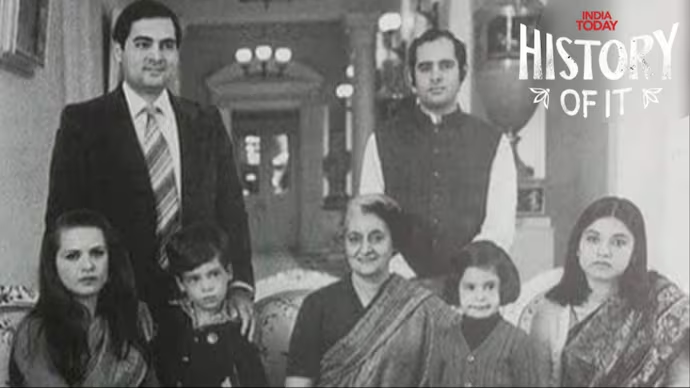


Despite such profound loss, Maneka Gandhi went on to build a life and carve an influential space for herself, not only as a leading female politician but notable public service to animals and the environment. With the money left to her by her late husband, she founded an animal welfare hospital and later (in 1992) established People for Animals, now India’s largest animal welfare organisation. She has been active in Indian politics for over 30 years, and has written several books on animal rights, law, and etymology.

View of animals as all equal and TV show “Heads or Tails” and banning mandatory killing of dogs
 Although we had never met before, Maneka—now 70—was open, direct, approachable yet someone who did not suffer fools too gladly (a bit like myself in that respect). She also shared some fascinating reflections and personal anecdotes about her early interest in animal welfare, stating that:
“I think I was born interested in animals, but it’s not so much interested in animals as I seriously don’t see the difference between an ant, a dog, an elephant, me. So, I was born with that kind of awareness.”
As well as her creating and hosting a documentary TV series (and book) called “Heads and Tails” which highlighted animal cruelty in India in the name of religious beliefs, superstitions, objects of food and other products of human consumption. It also highlights the work done by NGOs and other groups to rescue animals and create shelters for them. Gandhi also mentioned how:
“We stopped dissection in schools which used to be dissection in schools which used to be mandatory. We stopped the killing of dogs which used to be mandatory. “
The issue of stray dogs in India and the sterilisation programme

We then briefly discussed Maneka’s street dog sterilization campaign as opposed to euthanasia and animal shelters. I shared my own experience with Mrs Gandhi of being suddenly bitten deeply on the leg by a stray dog while near the Tibetan hospital in Dharamsala, early one evening in 2019, and how the locals there said the dog had bitten many people randomly without warning (but was not physically sick). Although the dog was clearly dangerous and harming people, the dog charities told me it was the responsibility of the local council, and they told me it was the dog charities, so nothing was ever done. She told me that one of the main issues is also that there is no place to house them, and killing is not the answer (which I agree with as a Buddhist)[i].
This year, Gandhi has recently spoken out against the Supreme Court of India’s order allowing euthanasia for rabid, incurably ill or demonstrably dangerous stray dogs. This is due to increased concerns over biting and injuries of children and citizens. Gandhi spoke briefly on her views as to how best to deal with the stray dog issue in India, which compared to other countries is a major issue still.
Eating meat in India, and the issues surrounding its sale and export in India, and Tibetan influences (good and bad)

When we moved onto the vegan diet and its importance to animals and the environment, Maleka spontaneously told me some personal anecdotes about the different experiences annd influences in India on eating meat and animal welfare, of two senior lineage holders in Tibetan Buddhism, the 14th Dalai Lama and 17th Karmapa.
First, Gandhi told me that she requested the 14th Dalai Lama to stop “boasting” about eating meat for health as it had a negative influence on people (here is the video clip on Youtube of this section):
“MG: Number two, in India, the Dalai Lama has caused a big problem because he openly talks about eating meat.”
AT: Well, this is a controversial subject. I spoke to Peter Singer about this as well, and a lot of people are very unhappy about it. I must admit, I also have some issues with it.”
“MG: I spoke to him and said, ‘Whether you eat meat or not, keep it quiet. Do not make a big thing of it. Do not say it in every interview.’ He then sent me his doctor, and later wrote me a letter saying, ‘I will become vegetarian because of you.’ So, for one year, he became vegetarian.
After one year, he sent the same doctor to me, saying that the Dalai Lama believed he had major health problems when he could not eat meat. So I said, ‘In that case, he must suit his body rather than his mind.’”
AT: That is an interesting story, but unfortunately, according to the Vinaya rules — the monastic rules — monastics are strictly forbidden from eating meat, even for health reasons. So whether one has a health issue or not is considered irrelevant in the Vinaya rules, unless one is starving or dying. In any case, this is a controversial subject.”
MG: Yes, but it should be dealt with. What happened was that Tibetans were not only eating meat; they were also responsible for a great deal of wildlife smuggling. They used to kill tigers, send them to Tibet, and in return receive deer wool, which was made into a shawl here called shahtoosh.
At one point, I became so upset that I decided to campaign to have the Tibetans expelled from India. At that point, the Dalai Lama sent me the letter saying, ‘I will become vegetarian,’ because I was making a big song and dance about it.”
Then, Gandhi told me how conversely, she felt the 17th Karmapa influenced vegetarianism and animal rights in India in a very positive way and was like an “angel” in that respect:
“MG: “However, as God would have it — or as the universe would have it — the 17th Karmapa came along. The Karmapa must be in his thirties now, but he is like an angel sent from God. There is something so powerful and spiritual about this young man.
As soon as he came from China, when he was about sixteen or seventeen, he immediately started talking about vegetarianism. Because of him, a large number of Tibetans became vegetarian.”
AT: Yes, that is right. I was actually in India at that time, when he gave a teaching under the Bodhi Tree at Bodh Gaya. He spoke about taking a lifelong vow of vegetarianism, and we were all asked to take it with him. I did so as well.
So yes, it had a huge effect on that culture. But a lot of people did not like him for it either. I think it also made him some enemies, because within that tradition there were many people, including monks, who were eating meat. As you say, there was also the example of the Dalai Lama. So when the Karmapa came out so strongly in favour of vegetarianism, I think it made some people within the community unhappy. But you are right — it was incredible.
MG: “Because of the Karmapa, animal shelters started in various places in India. One started in the Tibetan colonies in Karnataka, and hundreds and hundreds of people began looking after animals because he made it an issue.
I went with him to Bodh Gaya several times because he started an animal hospital there. Unfortunately, he was under house arrest most of the time. At some point, he became fed up and left India. I am told he is now in Japan, but I am not sure. I wish he would come back to India, because he was changing the whole community.
The second thing I need to say is that when the Buddha said, ‘Do not eat meat and go and beg for your food,’ he meant, in particular, that you cannot have Buddhist monasteries where food is catered for you. So all these monasteries in Ladakh, Darjeeling, and other Tibetan areas, where cooked food is provided to monks, are not really following that principle. I do not think the Buddha intended for pre-cooked meat to be given to monastics to eat.
In one particular case, Tibetans in Ladakh would take cows right up to the tops of mountains and throw them off, saying, ‘We did not kill them; gravity killed them.’ That has now stopped, but it stopped because of the Karmapa.”

[Last year, I also interviewed the famous animal rights philosopher and advocate, Prof. Peter Singer, he also made similar comments about the 14th Dalai Lama eating meat for health reasons, saying it was “absurd” that someone in India of that status could not eat alternatives to animal flesh, see clip here.
Mrs Gandhi also shared her thoughts on a popular belief that the Buddha was poisoned by pork as his final meal, as a mistranslation of the original Pali. Also, how the main issue in all environmental concerns and even conflict between Hindus and Muslims is due to meat (for example, their wanting to eat beef/cow in India where it is forbidden).

In terms of killing animals, we discussed the petition I had recently launched on Change.org to request a ban on the slaughter and selling of animals as food in and around sacred Buddhist sites, to which she joked (quite rightly) that all of India was a sacred site! We agreed that it was illegal in Indian law to keep and kill animals that way as one sees in Bodh Gaya, but that it needed people at the local authority to apply the laws, but all too often they were not willing to do so. That it required Buddhists and people there to see the animals and act with compassion and conscience.
The issue of banning slaughterhouses like Bhutan was also discussed, but Gandhi rightly pointed out, that the vast majority of Bhutanese eat meat and import all their meat from India.
“Saving, educating and protecting girls”

At the end of the interview, we briefly discussed her work and activities as Minister for Women and Child Development, during which she told me she had been able to pass laws on pensions for women. And the phrase she coined to reduce the femicide of girls pre and post birth, Beti Bachao, Beti Padhao”: Save girl child, educate girl child.
Conclusion: India leading the world on animal welfare and not eating animals and their produce?
For the record, I do not follow Indian politics and remain entirely impartial in that sphere. My reason for inviting Maneka Gandhi was to highlight her significant and beneficial work for animals in India. Whatever one’s political views, Maneka Gandhi stands as a prime example of resilience, intelligence, and courage—someone who has overcome immense hardship and used her life to benefit others in both public and private spheres. The fact that she, as a widow, lone mother and woman who has done that makes it even more inspiring.

Dedicating the merit to all animals on this planet, particularly those in slaughterhouses, that they may experience genuine love, compassion, care, empathy, respect and a life free from torture and death inflicted by humans.
Other Interviews
For other podcasts on Dakini Conversations on the topic of eating animals, animals rights and the environment, see:
Also for research and translations on eating animals and Buddhism, as well as a pdf compilation of the 17th Gyalwang Karmapa’s teachings on the topic, see here:
Vegetarianism/Animal and Environmental Advocacy
[i] That said, I personally know how traumatizing it can be to be bitten by a street dog. I love dogs and would often feed them biscuits as I walked around Dharamsala, but because this dog was lying peacefully on the ground and just bit me without any warning, a very deep bite in the leg, that took months to recover from, now whenever I see a dog, I instivintively feel nervous and apprehensive. Something only dog bite survivors will understand! Also, the Tibetan hospital nurse on duty refused to bandage it, or give first aid, even though it was bleeding profusely and needed cleaning right away, and insisted I get a taxi to the Indian hospital about fifteen minutes away.