
“The dakini is a figure who stands at the crossroads of memory and innovation, the personal and the transpersonal. In Jigme Lingpa’s secret autobiographies, she appears not merely as a passive muse, but as a troubling, direct, and sometimes annoying messenger of truth who forces the visionary to look past the conventional structures of the self.”–Prof. Janet Gyatso from Secret Autobiographies of Jigme Lingpa
For Dakini Day today, am re-posting Episode 2 (2023) of my podcast Dakini Conversations with Prof. Janet Gyatso (Harvard University) unpacking some of her groundbreaking research on Jigme Lingpa, the Secret Autobiographies of Jigme Lingpa, and the dakini archetype.
Jigme Lingpa, Rigdzin Jigme Lingpa (1729–1798) was one of the most influential Tibetan Buddhist masters, tertöns (treasure revealers), and writers of the Nyingma lineage. He is revered as a joint incarnation of the 8th-century King Trisong Detsen and the great master Vimalamitra. Jigme Lingpa famously revitalized the Great Perfection (Dzogchen) tradition at a time when it was becoming overly intellectualized.
Full video of podcast here:
It was a great delight and honour to talk with Prof. Janet Gyatso, the first and current Hershey Professor of Buddhist Studies at the Divinity School of Harvard University. In the Buddhist Studies and Tibetology world, Prof. Gyatso really needs no introduction, and is a prime example of a woman who has reached the peak of the academy, while at the same time writing original and thought-provoking research about issues connected to women, feminism, gender, androcentrism and Buddhism. If anyone might be awarded the title ‘Queen’ of the Buddhist Studies academy, Prof. Gyatso would surely be a prime contender!
On a personal note, I had quite a few obstacles doing this interview with Prof. Gyatso in 2023, and had already had to cancel it twice. Then the day before it was due to be recorded, I was suddenly severely bitten on the lower leg by a street dog outside the Tibetan Library in Dharamsala (without any warning or provocation). So I was not only recovering from a serious injury but also had just had two injections (tetanus and rabies) in a local Indian hospital! Nevertheless I tried my best to keep spirits up and a brave face on it as they say! The Dakini blessings perhaps ha ha ha . For more on the bite, see the endnote of this article here.
The interview provides critical contextual layers to how we understand the 19th Century Tantric Practitioner, Jigme Lingpa’s “secret-talk” with these mysterious, powerful and often “scary” female entities, Dakinis (Khandro in Tibetan):
1. Re-evaluating the “Dakini” Beyond Academic Criticism
In the interview, Gyatso and I explore the multi-faceted nature of the dakini—moving beyond structuralist and late-20th-century Western feminist critiques. Gyatso notes that while some modern Western scholars historically criticized Tibetan Buddhism for being patriarchal, looking directly at the inner tantric literary tradition reveals a highly subversive female agency.
2. The Language of the Dakini: “Untranslatable Words”

A major focus of their conversation centers on untranslatable words and the specialized code of the dakinis (Dakki’s Grand Secret-Speech). Gyatso explains that the dakini does not communicate through ordinary, linear logical structures. Instead, the dakini’s speech in Jigme Lingpa’s visions acts as:
• An abrasive, paradigm-shifting voice that deliberately shatters the practitioner’s ego and conventional concepts.
• A structural device in Tibetan terma (treasure revelation) literature where the dakini acts as the ultimate gatekeeper and legitimizer of the vision.
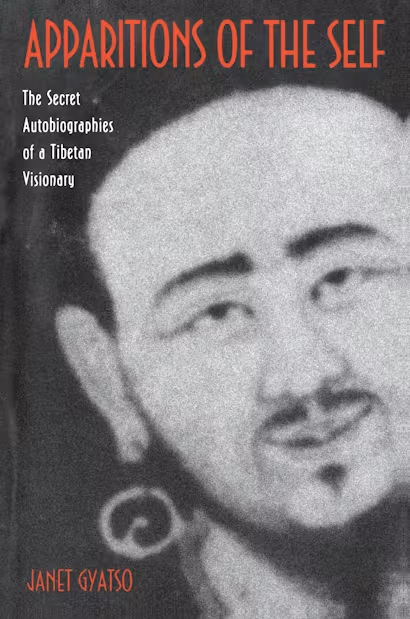
Gyatso speaks about even after speaking to various Tibetan Buddhist teachers and practitioners, some terms were “untranslatable” it seemed, and when she travelled to Nepal to approach Dilgo Khyentse Rinpoche about them, he told her not to translate one line, and keep it in Tibetan, which she did. it is the only line in her book that is in Tibetan. Also, Gyatso discusses the “Secret” aspect of his words, and how in her book she mentions an idea, given to her by Khenpo Jigme Phuntsog of Sertar Monastery, Tibet, about how we have to become the Dakini in order to understand the work.
3. Emptiness, Gender, and “Divine Pride”
Highlighting Prof. Gyatso’s ability to navigate the complex intersection of gender, sexuality, and the illusion of self in Tibetan literature, we discuss how meditating on female deities like Vajravarahi (Dorje Phagmo) or communicating with dakinis requires what Buddhism calls “Divine Pride”. Rather than reinforcing standard worldly gender identities, interacting with the dakini forces the practitioner to dissolve dualistic thinking of “self and other” to tap into primordial wisdom.
4. Why Jigme Lingpa’s Work Matters to Modern Women

We reflect on how Jigme Lingpa’s autobiographies broke rigid institutional Tibetan boundaries by openly displaying vulnerability, raw psychological states, and his reliance on female visionary guides.
Related Articles
Highlighting Gyatso’s work is a part of my broader effort to recover and celebrate the historically obscured lineages of female practitioners, mystics, and teachers across India and Tibet.
For an article I wrote about the Dakini Script (Khandro Da-Yig (2021), unintelligible to most, see here.

For a short clip from the interview with Prof. Janet Gyatso, discussing Gyatso’s book on Jigme Lingpa’s Secret Autobiographies and the Dakini’s role in their creation:
For audio-only podcast see: The audio-only podcast can also be downloaded and listened to on Spotify (https://open.spotify.com/show/3UfzdrhJgJw9g42RTFQqaL), Apple (https://podcasts.apple.com/…/dakini…/id1680411287), and Amazon Music.
P.S. Apologies for the sound quality of my microphone, this was one of my first DIY podcasts, and was using headphones……the content is what counts though 