

“The animals could not speak about the cages, the heat, the fear or the knife. They could not question the monastics who ate their slaughtered bodies or the institutions that permitted their sale on monastic property. They could not ask why prayers for universal compassion did not include them in reality. The least I could do was refuse to participate and refuse to pretend that the contradiction did not exist. But I was made to pay for that refusal and questioning it, in one way or another, as I discovered.”
“In India, the animals were not hidden away, as they often are in mass factory farms. They were plainly visible, crammed into small cages with no room to move, frequently left in the baking heat of the sun. At times, I could not bear to walk past them. The sight filled me with profound sorrow and helplessness. Why did the Tibetan Buddhists and monastics around me not seem to feel the same way? While they were chanting the mantra of compassion, they were actively supporting mass murder of animals on a daily basis for their personal diet.” –Adele Tomlin
Introduction
In another excerpt autobiographical chapter from the forthcoming book, I share part of my journey after taking a life-long vow with the 17th Karmapa in Bodh Gaya 2006, never to eat slaughtered animals again.
This more general chapter describes my experiences as a witness, student and pilgrim in India, and SE Asia to eating habits of Buddhists. Including monasteries and nunneries where I stayed or studied such as Sherab Ling monastery and Dolma Ling nunnery in Himachal Pradesh, India. Or attending courses and conferences as a guest speaker with Buddhist teachers and leaders, where animals and animal products were ALWAYS on the menu. Like people smoking cigarettes at a conference on curing cancer, it just seemed like the “elephant in the room” no-one wanted to debate or discuss. People who had studied Buddhist logic and scriptures for years, unable to or unwilling to debate the question as to why they were actively choosing to purchase and eat slaughtered animals regularly.
I hope this autobiographical excerpt inspires, provokes and leaves a lasting impression of a lone Buddhist woman’s struggle to make sense of people preaching love and compassion for all beings, who wilfully failed to see the unnecessary cruelty, torture and murder on their plates. Our precious teacher, Shakyamuni Buddha never taught it was alright to eat animals in the way most of us are doing now, and the scale and destruction of the slaughter is far bigger and worse than when Buddha was alive.
Here is a Facebook reel of my introducing this excerpt chapter:
Here is my recent song NoBody is a Product, and also a new clothing and accessories range (print on demand) Dakini Threads to raise funds and awareness of animals, the planet, women and awakening.
“NoBody is a Product, no life is property. Until all beings are free, none of us are free.”
CHAPTER from forthcoming Autobiography
Contradiction on the Plate: When Compassion and Devotion Ends where Appetite Begins

After taking a lifelong vegetarian vow beneath the Bodhi tree with the 17th Karmapa in Bodh Gaya in 2006 at the Kagyu Monlam Prayer Gathering, I became increasingly conscious of the profound contradiction between Buddhist teachings on compassion and the way many Buddhists actually lived.
The 17th Karmapa had spoken powerfully about the suffering caused by eating animals and urged those connected with him to stop eating animals as part of the Buddha’s teachings and within the Karma Kagyu lineage tradition, from 7th Karmapa onwards. He even related the practice to his own health and longevity. Yet many of his followers—Tibetan and foreign alike—appeared to disregard his advice almost immediately.
This was one of my earliest experiences of the gulf between professed devotion and actual conduct. People declared their faith in the 17th Karmapa, attended his teachings, received empowerments and spoke reverently about him as their guru. Yet when he asked them to make one clear and practical change that would reduce masses of suffering of millions of artificially bred animals and protect the natural resources of our precious planet, many simply continued as before.
Their devotion seemed to end where their appetites began.
It became apparent to me that there was a deeply entrenched attachment to meat within Tibetan Buddhist communities. This was not limited to Tibetans. Many European and North American practitioners surrounding them behaved in exactly the same way. They spoke at length about compassion, bodhicitta and the liberation of all sentient beings, while continuing to purchase and consume animals who had been deliberately bred, confined and slaughtered for food. Often they would say “Well the Dalai Lama eats meat” as if that somehows gave them a “free pass” to do the same. When his eating meat for health reasons was also questionable and had been criticised by many animal rights and environmental advocates.
The Buddha had also spoken clearly about livelihoods connected with harm. Trading in living beings and dealing in flesh were listed in the original Buddhist Sutras among the forms of wrong livelihood, alongside trades in weapons, intoxicants and poisons. Butchery, hunting and slaughter were plainly based upon taking life. Even when a person did not kill the animal with their own hands, purchasing its body still financially supported those whose income depended upon killing.
As I travelled as a pilgrim and student through India, Nepal and other parts of South and Southeast Asia, I began noticing these contradictions everywhere. In monasteries, nunneries, restaurants and cafés, Buddhists regularly ate meat—not only occasionally or in situations of necessity, but habitually and sometimes daily. Outside sacred pilgrimage sites, including internationally recognised heritage sites, such as the Bodhi temple, inm Bodh Gaya freshly slaughtered animal flesh was openly displayed and sold.
The contrast could be jarring. Within a sacred enclosure, pilgrims circumambulated shrines, recited mantras and prayed for all beings to be free from suffering. Just beyond its walls (or sometimes even within them), the bodies of recently killed animals hung from hooks or lay exposed on market stalls, or hidden huddled in small cages in pain and torture waiting to be killed for customers.
Serving animal flesh at the Land of Tārā (Dolma Ling) nunnery and absence of debate

One of the first places where this contradiction starkly confronted me on a personal level within a monastic institution was Dolma Ling Nunnery, near Norbulingka in the Dharamsala area. From 2017-2019 (until the COVID lockdown) I attended the nunnery Tibetan language classes as a layperson day student. I was the only foreigner there and speaking and understanding Tibetan was the pre-requisite, see another chapter on that.
The nunnery was beautiful and impressive. Its name, Dolma Ling, means the Land or Place of Tārā. Tārā is one of the great female embodiments of enlightened compassion. According to a well-known Buddhist account, she arose from a tear shed by Avalokiteśvara, the bodhisattva who personifies the compassion of all the Buddhas. The teachers and staff included Tibetan lay people who were friendly, helpful and well-educated.
Yet inside the grounds of this Land of Tārā was a nunnery operated/staffed restaurant that served meat.
The restaurant was open not only to the nuns but also to visitors and members of the public. Vegetarian food was served to the nuns by the nunnery in the canteen for students and residents there but I regularly saw nuns and Geshe monks choosing to eat and meet in the public restaurant too. They paid for their meals like any other customers, but the fact remained that slaughtered animals were being sold and consumed within the grounds of a Buddhist nunnery dedicated to a female embodiment of compassion and non-killing.
When I first saw this, I asked one of the nuns working there why meat was being served inside the nunnery. It seemed to me a straightforward and legitimate question. I was a Buddhist, a student at the institution and a member of the public using its facilities. Moreover, prominent Tibetan Buddhist teachers—including the Seventeenth Karmapa—had spoken publicly about giving up meat and preventing the suffering of animals.
Instead of a reasoned explanation, I received a look that conveyed irritation and something close to contempt. The implication seemed to be that the matter was none of my business and that merely raising it was inappropriate as a “crazy westerner” (injee nyonpa) as we were sometimes pejoratively referred to. I never mentioned it again, conscious that I was studying there and saying more could make it difficult for me.
While having my morning chai and aloo paratha at a small Indian dhaba, I would often see nuns and monks from the nearby nunnery and neighbouring monasteries visit a small slaughter shack opposite the Norbulingka Institute to order and pay for freshly killed chickens.
In India, the animals were not hidden away, as they often are in mass factory farms. They were plainly visible, crammed into small cages with no room to move, frequently left in the baking heat of the sun. At times, I could not bear to walk past them. The sight filled me with profound sorrow and helplessness. Why did the Tibetan Buddhists and monastics around me not seem to feel the same way?
There was also a private restaurant just outside the nunnery gates that sold freshly slaughtered meat. From the apartment I rented next door, I could hear the repeated blows of the chopping knife—the sounds of fear, violence and killing immediately beside a Buddhist nunnery: a place supposedly dedicated to non-harm, peace, harmony and awakening for the sake of all beings.”
What happened to logic and debate?

What struck me most was that Dolma Ling was renowned for educating nuns in Buddhist philosophy and debate. Many of the women were undertaking the long and demanding course of study required to become Geshemas, the female equivalent of the traditionally male Geshe degree. This represented an important development in women’s education and status within Tibetan Buddhism.
To qualify, the nuns spent many years studying logic, philosophy and canonical texts like the monks. They memorised complex arguments and were trained to test assertions through structured debate. They learned, at least in principle, to analyse a position rationally rather than dismissing the person who raised it.
Yet when I asked a simple ethical question—why animals were being sold as food inside a Buddhist nunnery—the culture of logic and debate seemed to disappear. There was no discussion of compassion, intention, necessity, livelihood or the consequences of financially supporting slaughter. There was no attempt to explain why the practice was considered acceptable.
This became part of a pattern I would encounter repeatedly. Buddhist institutions were often willing to debate abstract philosophical questions of extraordinary complexity: the nature of emptiness, the existence of external phenomena, the divisions of consciousness or the precise stages of the path to enlightenment. Yet a practical question about the suffering of an animal on someone’s plate could provoke defensiveness, ridicule or silence.
The intellect was welcomed when it protected tradition. It was less welcome when it challenged habit.
My concern was not that every Buddhist had to reach exactly the same conclusion as I had. Nor did I deny the historical hardships experienced by Tibetan communities living in regions where plant foods were sometimes scarce. My concern was the refusal to examine whether those historical justifications remained valid in modern circumstances, particularly among people living in India, Nepal, Europe or North America, where vegetarian food was readily available.
The continued consumption of meat was often defended as culture, tradition or personal choice. But the animal had no choice.
These experiences contributed to my growing disillusionment—not with the Buddha’s teachings on compassion, which appeared to me more necessary than ever, but with the selective way in which those teachings were practised and the communities who ignore scripture and reason.
When compassion entered the dining room, it was frequently asked to remain silent.
The 17th Karmapa’s teachings, Pilgrimage and Appetite
My concern deepened as I researched the subject. In March 2024, I wrote an article for a Buddhist magazine and online platform (Buddhist Door Global) which had originally been commissioned by Tricycle Magazine, but after weeks of back and forth editing, the senior editor dropped it “like a hot brick” for spurious reasons.
I listened carefully to and transcribed teachings given in Tibetan by the Seventeenth Karmapa, particularly during the period around 2024 and 2025. He spoke in considerable depth about the Vinaya, monastic discipline and the history of abstaining from meat within the Karma Kagyu tradition. I noticed how the official reports of those teachings, were not transcripts but edited, and seemed to leave out crucial aspects of those teachings. Could it be because the editor and writing team were meat-eaters themselves and so “watered-down” the powerful teachings?
In particular, the 17th Karmapa’s teachings challenged the common assumption that vegetarianism was somehow alien to Tibetan Buddhism. He discussed previous Karmapas and lineage masters who had opposed the killing and consumption of animals, showing that this was not merely a modern concession to Western sensibilities. It had deep roots within the tradition itself.
I also interviewed the US scholar Dr Geoffrey Barstow, whose research has documented Tibetan debates about vegetarianism and translated writings by masters who rejected meat. His work revealed a history far more complex than the familiar claim that Tibetans had always needed to eat animals because the Tibetan landscape could not sustain sufficient plant food.
Geography undoubtedly shaped Tibetan diets, and survival in high-altitude environments was often extremely difficult. But necessity could not explain everything. Historically, there had been major Tibetan masters who abstained from meat even under those conditions and urged others to do the same. Within the Karma Kagyu lineage, several Karmapas strongly discouraged or prohibited meat. Similar examples existed in other traditions, including among masters of the Jonang and Nyingma lineages.
Some teachers even prohibited meat within tantric ritual contexts, where its use was sometimes defended as traditional or symbolically necessary. The Karmapas, I learned, had at times forbidden actual flesh from being presented as an offering, insisting that symbolic substitutes be used instead.
Yet when I looked at contemporary Buddhist life, very few prominent masters seemed willing to address the issue directly. The Seventeenth Karmapa was one of the notable exceptions. Many other teachers remained silent, while some appeared to provide their followers with theological or cultural justifications for continuing to eat animals.
One of the most frequently cited justifications concerned the Buddhist rule sometimes described as the “threefold purity” of meat. In early monastic contexts, monks and nuns lived on alms. They were expected to accept what was placed into their bowls rather than demand specially prepared food. Meat could be accepted, according to one traditional formulation, when the monastic had not seen, heard or suspected that the animal had been killed specifically for them.
This rule emerged within a particular social and economic world. Monastics were mendicants. They did not enter restaurants, select dishes from menus and pay businesses that ordered animals to be slaughtered according to consumer demand.
Yet in modern Buddhist communities, the rule was often treated as a general licence to purchase meat, provided the buyer had not personally ordered the death of a particular animal.
When customers repeatedly purchase meat from restaurants, supermarkets or market stalls, they create the demand that causes more animals to be bred and killed. The fact that the butcher did not know the customer’s name before slaughtering the animal does not make the customer unrelated to the killing. The economic connection remains obvious.
Modern industrial farming makes this even clearer. Vast numbers of animals are bred for no purpose other than to be sold as food. They are killed in anticipation of consumer demand. To insist that an animal was not killed “for me” simply because I did not select that individual animal in advance seemed to me an exercise in evasion rather than ethical reasoning.
The “absurdity” of the 14th Dalai Lama eating meat and Bodhi Temple restaurants

This debate also surrounded the Fourteenth Dalai Lama, who had publicly explained that he continued to eat some meat for health reasons and on the advice of Tibetan doctors. His position was frequently criticised by animal advocates, particularly because someone with his resources and global influence might be expected to have access to excellent nutritional advice and a wide range of alternatives.
I discussed this question in an interview with the philosopher Peter Singer, whose work on animal ethics had become internationally influential following the publication of Animal Liberation in the 1970s. Singer found it difficult to understand why a religious leader of such stature could not obtain a nutritionally adequate vegetarian diet.
A doctor’s recommendation to one person became a justification for thousands of followers. The historical hardship of nomads on the Tibetan plateau became a defence for diners in European cities. A monastic rule about accepting unsolicited alms became permission to order meat from a restaurant.
The Tso Pema, Rewalsar and Bodhi Temple chicken shacks and restaurants


One of the most disturbing examples occurred at Tso Pema, also known as Rewalsar, a pilgrimage site in northern India closely associated with Guru Padmasambhava. The area was filled with monasteries, nunneries, caves and small meditation huts. Practitioners came there to undertake retreats, recite prayers and meditate in a landscape regarded as profoundly blessed.
Yet immediately outside this sacred area were makeshift stalls where animals were sold and killed.
I remember seeing chickens crammed together in cages beneath the baking midday sun. They had scarcely enough room to move. They waited there, distressed and overheated, until someone selected them to be slaughtered.
The sight was not hidden away. It existed openly, directly beside monasteries and nunneries, within the immediate environment of one of the region’s most revered pilgrimage sites.
Inside the temples, practitioners prayed to Guru Padmasambhava and recited aspirations for all sentient beings. Outside, sentient beings waited in cages to have their throats cut by same practitioner, including monastics.
Nowhere did I feel these contradictions more intensely than in Bodh Gaya. The Mahabodhi Temple marks the place where the Buddha is believed to have attained awakening beneath the Bodhi tree. For Buddhists, it is among the most sacred places in the world.
Yet around Bodh Gaya, I saw market stalls and small shops selling freshly killed animals. I saw Tibetan monks, nuns and laypeople purchasing meat without any visible hesitation. Restaurants surrounding the temple regularly served it to pilgrims.
I spoke with some Indian restaurant owners and asked why they sold meat so close to the place of the Buddha’s enlightenment. Their answer was simple: demand.
They told me that before Bodh Gaya became such a large international pilgrimage and tourist centre, many local Indians had eaten a predominantly vegetarian diet of rice, dal and vegetables. The increased trade in meat had developed partly to satisfy the preferences of visitors, including Tibetans and foreigners.
This seemed to me a particularly sad indictment of the cultures gathering at Bodh Gaya. Pilgrims had travelled enormous distances to honour the Buddha, receive teachings and accumulate merit. Yet their presence had apparently contributed to an increased demand for killing in the immediate surroundings of the sacred site.
They came to commemorate awakening, and animals died to feed them.
It was easy to speak of universal compassion in the abstract. It was easy to pray that all beings might be free from suffering. It was far more difficult to confront the suffering hidden inside familiar habits, especially when those habits were shared by one’s family, teachers and religious community.

My concerns about the Fourteenth Dalai Lama’s public position on meat were reinforced when I later interviewed Maneka Gandhi, one of India’s best-known animal-welfare campaigners and the founder of People for Animals. She had also held prominent public roles and was a member of the Nehru–Gandhi family through her marriage to Sanjay Gandhi, the son of former prime minister Indira Gandhi.
During our conversation, she spontaneously raised the subject of the Dalai Lama’s meat consumption. She told me that she had spoken to him directly and expressed her frustration about the way he “boasted about” eating meat in public. In her view, whatever health reasons he might offer, his remarks gave people the wrong impression. Because of his immense moral and spiritual influence, his personal behaviour could easily be interpreted by others as permission or endorsement.
According to Maneka Gandhi, she asked him to stop eating meat, and he initially told her that he would give it up for her. She also raised concerns about Tibetans hunting wildlife in India for fur. Later, however, she was told that his Tibetan doctor believed he needed meat for his health, and the earlier promise was not maintained.
What struck me was not merely the question of one individual’s diet. It was the larger pattern of exemption. Whenever Buddhist teachings came into conflict with meat consumption, an exception seemed to appear: geography, culture, health, tantric custom, medical advice or an accommodating interpretation of the Vinaya.
The ethical implications of their example were considerable. When an ordinary person eats meat, that decision affects the animals purchased for their consumption. When a globally revered Buddhist teacher publicly defends eating meat, the consequences may extend much further. Followers who might otherwise question their own habits can point to the teacher and conclude that no serious contradiction exists.
For me, the health argument also failed to address the monastic and ethical questions. Buddhist discussions of meat were not originally concerned only with whether it was physically beneficial or harmful. They concerned intention, killing, demand, livelihood and the responsibilities of those who had renounced ordinary worldly life.
The precise interpretation of the early monastic rules has long been debated, and different Buddhist traditions have reached different conclusions. Yet it seemed clear to me that freely entering a restaurant and purchasing meat was morally different from a mendicant unexpectedly receiving unwanted food in an alms bowl.
For monastics especially, the attempt to apply an ancient alms-bowl exception to modern restaurant dining seemed indefensible. Choosing a meat dish, ordering it and paying for it bore no resemblance to unexpectedly receiving food while begging and having no control over what was offered.
The Seventeenth Karmapa also spoke about the damaging impression created when Buddhists, particularly monks and nuns, openly ate meat. His argument was not based only upon detailed scriptural interpretation. He appealed to something more immediate: our natural response to suffering.
When small children see an animal being harmed, they often cry out. They do not need to consult scripture or debate the philosophical status of the animal’s consciousness. They recognise fear and pain directly.
Many adults respond in the same way when confronted with slaughter. They recoil, turn away or become distressed. Yet once the body has been cut into pieces, packaged and placed on a plate, the connection is deliberately obscured.
The 17th Karmapa urged people to preserve that instinctive compassion rather than suppress it. Compassion, he suggested, should not require elaborate permission. It should arise as naturally as responding to an ordinary bodily need. We do not conduct a philosophical debate before going to the toilet. In the same way, we should not require complicated arguments before responding to the unnecessary suffering of another being.
The animal is afraid.
The animal feels pain.
The animal does not wish to die.
The suffering is unnecessary.
For Mahayana Buddhists, the contradiction is more striking still. Practitioners are repeatedly taught to regard every sentient being as having once been their mother. This contemplation is intended to break down indifference and awaken gratitude, tenderness and responsibility.
If we genuinely regarded the animal before us as our mother, how could we calmly purchase and consume her body?
If someone placed the flesh of our human mother before us and instructed us to eat it, we would respond with horror and grief. We would not claim that we could eat her compassionately. We would not say that because we had not personally killed her, our actions had no relationship to her death.
Ignoring the teachings and “private” business: Palpung Sherab Ling’s restaurant

Several years later in February-March 2026, I stayed at Palpung Sherab Ling Monastery in Himachal Pradesh, India, the principal seat of the Twelfth Tai Situ Rinpoche.
Because Sherab Ling belonged to the Karma Kagyu tradition, I assumed that the Seventeenth Karmapa’s teachings on vegetarianism would be taken especially seriously there. The Karmapa is generally regarded as the principal head of the Karma Kagyu lineage, while the Tai Situ Rinpoches have historically held a close relationship with the Karmapas, sometimes serving as their teachers during the Karmapas’ youth.
The Seventeenth Karmapa had spoken strongly about removing meat from Karma Kagyu monasteries and monastic kitchens. I therefore expected Sherab Ling to embody that policy, or at least to be moving visibly in that direction.
Instead, I discovered a private restaurant operating inside the monastery grounds.
The restaurant was situated above a small shop that sold groceries and everyday goods to monks and visitors. It was not outside the monastery boundary or in a neighbouring village. It was part of the commercial life taking place within the monastic compound.
Every day, the restaurant sold meat.
I regularly saw monks eating there, including monks who appeared to hold senior positions. Nuns, lay visitors and other guests also used it. The meat was not being placed unexpectedly into the bowls of mendicants who had no power to refuse it. Customers entered the restaurant, selected meals, paid for them and ate them by choice.
After everything the Karmapa had taught, I found this bizarre and also sad.
I asked members of staff why slaughtered animals were being sold as food within a Karma Kagyu monastery. I referred both to Buddhist teachings on killing and to the Karmapa’s specific instructions concerning meat in monastic institutions.
They seemed unsure how to answer.
A monk who was present told me that he personally did not eat meat. However, he said the restaurant was a private business and that the monastery therefore could not prevent it from selling meat.
The reasoning made little sense to me.
A monastery could plainly regulate commercial activity conducted on its own grounds. It could decide whether alcohol, cigarettes or other prohibited products were sold there. It imposed rules concerning visitors, residents, behaviour and the use of monastic property. Why, then, would it be powerless to regulate the sale of slaughtered animals?
The phrase “private business” seemed to function less as a genuine explanation than as a way of creating moral distance. The institution could benefit from or permit a business within its boundaries while claiming no responsibility for what that business sold.
Once again, responsibility disappeared into an administrative technicality.
The situation also made me wonder whether there was a deeper disagreement between the Twelfth Tai Situ Rinpoche and the Seventeenth Karmapa over meat consumption. I could not know the private nature of their relationship, and I did not want to claim knowledge I did not possess. But the public practice at Sherab Ling appeared difficult to reconcile with the Karmapa’s stated position.
This impression was strengthened by a conversation I had with a Western nun who had recently ordained. I was shocked to see her post a photo of herself eating meat on her Facebook page and told her so. Particularly, as it went against all the teachings of Buddha and the 17th Karmapa, the supreme head of Karma Kagyu.\
She told me that she had not been eating meat. When she met Tai Situ Rinpoche, however, he reportedly asked her about her diet and advised her to eat meat, warning that otherwise she might develop what Tibetans call lung—a disturbance associated in Tibetan medicine with the wind element and sometimes linked with anxiety, agitation or energetic imbalance.
I was shocked by what she told me.
Here was a newly ordained nun who had already chosen not to eat animals, apparently being encouraged by a senior Karma Kagyu teacher to begin doing so. The advice seemed to contradict not only the Karmapa’s public teachings but also the historical examples within the lineage that I had been researching.
It was another instance in which a medical or energetic explanation was used to override an ethical commitment.
I had learned from my experience at Dolma Ling that openly challenging institutional practices rarely produced meaningful discussion. I therefore said little more about the restaurant while I was staying at Sherab Ling.
Discovering the Buddha Within: A French monk’s assertion that “killing animals” was permissible as a monk and Gyalton Rinpoche’s confession that he eats meat

This impression was reinforced outside Sherab Ling as well, during the Discovering the Buddha Within course in Prague, Europe in August 2025. One of the instructors was a French monk connected with Sherab Ling, Damien Dampa, a well-meaning person who at least was very communicative, but whose bullying and defamatory conduct towards me as a lone woman and survivor I will discuss more fully in another chapter.
During one session, he told the group that a monk who killed an animal would not automatically lose his monastic ordination, whereas deliberately killing a human being would constitute such a breach.
I understood that he may have been attempting to explain the technical hierarchy of offences contained within the Vinaya. Nevertheless, the way the point was presented appeared to me to give the impression that killing an animal was, in some sense, acceptable for a monk. I challenged him about this privately after the session finished, because I believed that distinguishing the formal consequences of different offences should never become a means of minimising the gravity of deliberately taking an animal’s life.
A rule stating that two actions carry different disciplinary consequences does not make the lesser offence morally harmless. To me, any explanation of the Vinaya that left students believing a monk could intentionally kill an animal without seriously violating Buddhist ethics was profoundly misleading.

Prior to that during the same period, I also had an opportunity to walk around Berlin for a few hours with a small group and Gyalton Rinpoche, another teacher connected with Sherab Ling. I asked him directly whether he ate meat. To my disappointment, he told me that he sometimes did.
Once again, I was confronted by the same contradiction. These were Karma Kagyu monastics associated with Sherab Ling, teaching and leading meditations on the “Buddha Nature Within” all beings, including animals, yet their words and conduct appeared difficult to reconcile with the Seventeenth Karmapa’s repeated teachings against eating animals and with the wider Buddhist commitment and monastic Vinaya to refrain from taking life, or supporting those who do for profit.
The question was no longer simply whether one restaurant inside one monastery served meat. The attitudes I encountered appeared to extend beyond the restaurant and into the teaching culture surrounding the institution itself.
Constructive suggestions for Sherab Ling: no meat, flowers, art gallery
Before leaving Sherab Ling in March 2026, however, I wrote to Lama Drakpa, the General Secretary administrator of the 12th Tai Situ Rinpoche’s Sherab Ling labrang, or ecclesiastical office. My letter did not concern meat alone. I included several constructive suggestions about the monastery.
For example, I proposed creating a flower garden around the golden stupa of the Eighth Tai Situ Rinpoche. The surrounding area appeared neglected in comparison with the better-maintained central monastery grounds, and I felt that the stupa deserved a more beautiful and cared-for setting.
I also suggested establishing a proper gallery for the Twelfth Tai Situ Rinpoche’s calligraphy. At the time, small reproductions of his work were displayed on the walls of a worn canteen-like space that appeared not to have been redecorated for many years. The works seemed diminished by their setting. Larger prints in a clean, dedicated room would have allowed visitors to appreciate them properly.
Among these suggestions, I also asked that the sale of meat on the monastic premises be stopped. I explained why I believed it was inconsistent with Buddhist ethics, Karma Kagyu history and the teachings of the Seventeenth Karmapa.
I received no substantive response to any of these concerns.

Soon afterwards, I received a letter from Lama Drakpa in response including a draconian ban forbidding me from visiting the monastery again (or any other Palpung centres) without any prior warning or discussion. It was harshly punitive and defamatory rather than open to reasonable debate or discussion.
In the “official letter” he mentioned his personal dislike of the White Tara artwork, the suggestion for my wanting to fundraise privately for a flower garden, and falsely accused me of “inappropriate conduct” with Gyalton Rinpoche, based on admin hearsay and unproven evidence. Moreover he used the chance to “lecture” me a scholar-researcher about his loathing of my research on Gelugpa sectarian violence and history in Tibet and its connection to the Tai Situpa lineage, as if he were some “judge and jury” Dharma protector, when in reality he was abusing his power to make judgements he was not in a position to fairly (or even lawfully) make in relation to a lone Buddhist woman.
It did not meaningfully address my concern for the animals, nor did it address disturbing events I had also raised in an email to him two days before, where I had been bullied and harassed personally twice during my final week at the monastery by an “irate and angry” European woman who had just arrived to stay there (a survivor of abuse of the same teacher)—events I will describe in a later chapter.
I could not know with certainty whether my comments about the restaurant had contributed to this harsh response. Nevertheless, the experience and lack of response about eating animals on monastery grounds next to the main shrine, left me with the strong impression that raising ethical questions was treated as an act of disloyalty and disrespect. So that compassion was lacking not only for animals but for lone women too. Yet, logic and debate were also one of the major subjects studied at the Sherab Ling monastery shedra.
This was becoming another recurring feature of my encounters with Buddhist institutions and their administrative gatekeepers. Devotion was said to require honesty, courage and a willingness to examine one’s own mind. Yet institutional loyalty often seemed to demand the opposite: silence, compliance and the suppression of uncomfortable observations.
A Mass Modern Scale of Active Breeding, Murder and Suffering
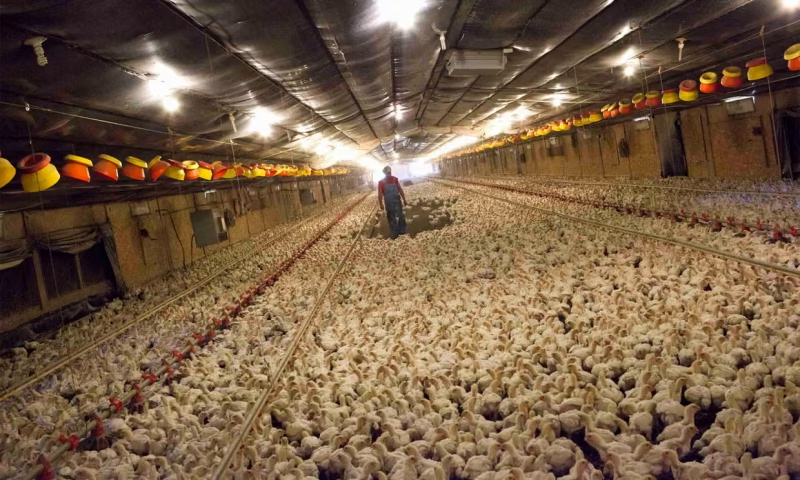
The Buddha identified occupations connected with killing and the sale of animals or flesh as forms of harmful livelihood. Tibetan saints such as Milarepa also condemned hunting and urged those who killed animals to abandon their trade. In one of the most famous episodes from his life, Milarepa confronted a hunter with the suffering caused by his actions and encouraged him to renounce killing.
Modern meat production is not primarily a matter of an occasional village animal being killed for a family or community. It is an industrial system in which billions of sentient beings are deliberately bred, confined and slaughtered. Many spend their entire lives in conditions that prevent natural movement or behaviour. They may be transported over long distances, handled violently and killed amid the terror of other animals.
The environmental consequences also extend far beyond the individual animal. Industrial livestock production consumes enormous quantities of land, crops and water. It contributes to deforestation, pollution and greenhouse-gas emissions, while food that could be eaten directly by human beings is instead fed to animals raised for slaughter.
The modern consumer is not living in the social world of an ancient mendicant monk. Most people who buy meat today are participating in a highly organised commercial system designed to breed and kill animals in response to predictable demand.
Money functions as an instruction. Every purchase tells the seller to obtain more of the same product. Every meat dish bought from a restaurant contributes, however slightly, to the demand that another animal be bred and killed.
This was why the restaurants at Dolma Ling and Sherab Ling mattered to me. They were not merely places where individual Buddhists made private dietary decisions. They were businesses operating within religious institutions and responding to the purchasing choices of monks, nuns, pilgrims and visitors.
The institutions had the power to establish a boundary. They could have said that whatever people chose to do elsewhere, animals would not be sold as food on sacred monastic ground.
The Buddha’s teachings on compassion were honoured in paintings, prayers and philosophical debates. But when those teachings threatened a profitable business or a deeply rooted appetite, they became negotiable.
Meat was being served not only by careless individuals but within monasteries and nunneries. Senior teachers either remained silent or gave advice that appeared to legitimise its consumption. Scriptural exceptions designed for mendicants were expanded into general permissions for consumers. Those who raised questions were met not with debate but with defensiveness, avoidance or hostility.
Trying to Effect Change : Drawing a Boundary around sacred Buddhist sites

Frustrated by the constant murder and consumption, and cruelty shown to animals at these sacred Buddhist pilgimage sites, in November 2025, I created a petition on Change.org calling for the slaughter and sale of animals to be prohibited within a clearly defined distance of the Mahabodhi Temple and other major Buddhist pilgrimage sites. My proposal was modest. I was not attempting to change the laws of an entire country or impose a particular diet upon everyone. I was asking for a protected ethical boundary around places regarded as sacred because of their association with awakening, compassion and non-harm.
The petition called upon the local authorities to prevent businesses based upon slaughter from operating in the immediate surroundings of the temple. Similar protections, I suggested, could eventually be established around monasteries, nunneries and other important Buddhist sites throughout India and Asia.
Several hundred people signed the petition. Their support showed me that I was not alone in finding the situation disturbing. There were Buddhists and non-Buddhists who also believed that sacred spaces should embody the principles for which they were revered.
I sent it to the Bodhi Temple management for their consideration. Gradually, the momentum faded. The petition remained online, but it did not produce the change I had hoped for. The stalls continued operating. Restaurants continued serving meat. Pilgrims continued purchasing it. Animals continued to be confined and slaughtered within sight of temples dedicated to compassion.
Animals themselves had no voice within these institutions. They could not enter a debate hall and argue that their suffering mattered. They could not appeal to monastic authorities, write to government departments or challenge the religious interpretations used to justify their deaths.
I also spoke about the principle of ahimsa—non-harm—at an Indian conference in which I participated online. Ahimsa is one of the most ancient and influential ethical ideals of Indian civilisation. It is not unique to Buddhism, but lies at the heart of several Indian religious and philosophical traditions.
People in India told me that the scale of meat consumption around some pilgrimage sites was relatively recent and had increased with tourism and the arrival of larger numbers of foreign and Tibetan visitors. Whatever the precise history, it was clear that these businesses survived because customers supported them.
Although the petition failed to bring about any immediate change, I do not regard it as entirely meaningless. It placed an objection on the public record. It stated that what was happening should not be accepted as normal or inevitable.
One can only hope and pray that one day Buddhist communities will establish clear boundaries around sacred places. Monasteries, nunneries and pilgrimage centres could simply declare that businesses founded upon slaughter will not be permitted within their grounds or immediate surroundings.
Such a policy would not solve the vast problem of animal suffering. But it would be a beginning. It would demonstrate that Buddhist compassion has practical consequences and that some forms of commerce are incompatible with sacred space.
Again and again, I heard the same defences. Meat was said to be necessary for health. The animal had supposedly not been killed for the particular person eating it. The killing had occurred elsewhere. The buyer had not personally requested it. It was part of Tibetan culture, tantric practice or local custom.
But no amount of verbal distance could alter the physical reality. An animal who wished to live had been killed. Money had been exchanged for its body. That purchase contributed to the demand for another animal to be bred and slaughtered.
My petition did not change the killing of animals for food in Bodh Gaya. My questions did not change the selling of slaughtered animals at restaurants at Dolma Ling or Sherab Ling. My conversations did not persuade Buddhist institutions to draw the boundaries I believed were necessary.
But the animals could not speak about the cages, the heat, the fear or the knife. They could not question the monks who ate their bodies or the institutions that permitted their sale. They could not ask why prayers for universal compassion did not include them.
The least I could do was refuse to participate and refuse to pretend that the contradiction did not exist.
What disillusioned and depressed me was discovering how despite years of practice and study of Buddhist scriptures, often Buddhist institutions, teachers and monastics had also learned not to hear or see the suffering of the very sentient beings for whom they chanted rote prayers for every day. Yet actions always speak louder than words.
👁 ❤️
I really do sympathize with u Bhadri.
Just a few thought-perspectives,,
Good fortune and karma partners well wih Humility.
”If IT’S not done for It’s own sake, there can be no real benefit.” Said Mila.
After spending 35+ yrs with the Lamas of Tibet both Asian and anglo incarnates and their ‘fledgling Sangha”s”’ full of good intentions’ one must keep in mind that we are still building bridges to understand the values of cultural, social and Spiritual succession.
~Yes,things need to change, but maybe not all at once.
Because in our world of No-self, self serving preservation still reigns supreme whether Enlightened or not.
Probably chuck it up to Instinct.
So as you most eloquently put things, one can really
Determine that honesty of your own intentions and actions are what you are accountable for.
So if the shit is hitting the fan and people seem to be behaving poorly and maliciously..then one must determine what of your own actions are inciting such jealousies and insecurities in others. I.e. how can it be your responsibility, for Therein lies the rub..and the power to augment change for the Better. Because, You know..and you have the compassionate view, to engage in Good ol’ fashion dialogue.
Each individual involved is a manifestation
of the ironing out and opening up of what must inevitably Occur, as painful, tedious and excruciating as it may seem. The Growing pains for all the Yanas.
I get the feeling (following yur version of yur escapades here on DT.) That youve become a discomfort due your openness and self exposure, something that most people would be uncomfortable with and your courage to overstep the boundaries may be seen as a threat.(to the status quo)
Although, if we are in the habit of highlighting problems, there’ll be endless plays of emotional retardation in the ranks.
Amongst all That Wisdom.
With regard to well wished ideas for the beautification of Palpung
There is a seeming endless growth and expansion of the physical grounds there. And w/o a doubt, plans were in the works for everything eventually. I think a little inquiry with the locals before hand may have eased that situation with Lama Dragpa as once again there are deeply established cultural norms that one need be sensitive to.
Ballsy ballsie.
👁 ❤️. 🐑
I do not think LD was interested at all in the ideas about the flower garden, the neglected land around the stupa, a small art gallery for the calligraphy of TSR, nor the idea re stopping sale of meat on monastery grounds to monks and nuns in a private restaurant. If he was interested in supporting these ideas, he would have shown that in words and actions. Instead, he showed something else, zero response and an excessive punitive reponse banning me from Palpung, zero discussion or warning, and based on his personal views about the garden idea, White Tara artwork, my writing on gelug research and TSR lineage, and falsely accusuing me of “inappropriate conduct” with GR, based on hearsay gossip, zero proof about alleged incidents outside India that happened over six months before.
What “cultural norms” are you referring to with the locals? It was nothing to do with that at all. These monks do not seem to be familiar with having calm, face to face, objective, friendly, communicative, mature discsussions with people, especially women who are survivors of misconduct by one of their male lama friends, which they continue to ignore and gaslight, despite there being other complaints of similar conduct by other women. “Emotional retardation” and major sexual repression that leaks out as loathing of women/misogyny and seeking sexual domination is an understatement…..