
“Relying on/serving a guru has been described in many stainless tantras, I shall explain it in brief. Listen respectfully to this.” –lines from opening verse of Fifty Verses on the Guru
“In particular, Dromptonpa said there is this tradition of saying “I prostrate to the Lord of Secrets” at the beginning of Vajrayana texts. In any case, when we say secret, if secret mantra is practised in secret then you accomplish the siddhis. If you do not practice secretly and hidden, no matter who you are and you publicise it to everyone, in particular, if you reveal secrets to people who are not appropriate vessels, then you will not achieve the siddhis.”
“So at that time, the Kadampa masters were very strict with Vajrayana practice, they generally practised it in private. They really never showed anyone they did such practice. Even with the mudras, they would do them underneath their robes. When they were having their midday meal, there were a few mudras you should do when reciting the texts. They were worried that other people might see them. In any case, they would only do it under their robes, not like people do now like showing off their hand mudras, instead of thinking that other people might see them, and make huge circles with their hands. Actually, if you are really practising secret mantra, that is how you should do it. You should practice in secret and private.”
Introduction
For the third day of the Fifty Verses on the Guru teaching by 17th Gyalwang Karmapa, Ogyen Trinley Dorje (after a long delay of several days due to sickness), the Karmapa first explained why he had to delay the teachings due to sickness and not having been able to get rest during that time, and ended with saying that when teaching such a sacred and important topic on secret mantra, obstacles often arise but that he still thought it might be beneficial to teach it nonetheless.
The teaching referred to one of the earliest commentaries on the root text by Tibetan master, Drogon Phagpa Chogyel and also an Indian/Sanskrit commentary . In that respect, the 17th Karmapa is giving a unique and significant teaching as most contemporary teachings focus on the one by Je Tsongkhapa. In addition, the Karmapa is using Sanskrit sources and Chinese translations of the root text.
The main focus was on the opening stanza and the meaning of ‘Glorious Vajrasattva’ (Palden Dorje Sempa), to whom the opening verse pays homage to. ‘Glorious’ (palden) meaning the accumulations of merit and primordial awareness. Vajra (Dorje) means possessing the seven qualities of a vajra such as indestructibility and so on, and Sattva (Sempa) means one who is never discouraged or perishes.
Interestingly, the 17th Karmapa spoke a little about how secret mantra used to be practised by the Kadampa Kagyu forefathers in the monasteries, and that they were so strict about doing secret mantra secretly and only giving one to one teachings (even if the students had entered the same mandala of the empowerment), that they would do mudras under their robes while having lunch and so on [1]. I have made a short video clip of this part of the teaching (with the original Tibetan and English subtitles here). Frankly, there are many teachers out there giving secret mantra empowerments online to people who sign up whom they have never even met or know. I even attended an online empowerment of Vajrayogini (a highest yoga tantra deity), after which the sadhana was taught to a group of people whom the teacher had never met and knew little about. When I wrote to the organisers to raise this as an issue, again I was treated as the ‘troublemaker’, so I left and did not continue with it. This clear teaching by the 17th Karmapa confirms my intuition and feeling on this.
The rest of the teaching was discussing the meaning of the words (tsig-don) and why it was important to pay homage/prostrate to the guru and why the opening verse spoke about paying homage to Vajrasattva in particular. Also, what the ‘actual’ Fifty Verses on the Guru is, not the text, nor the listening to it, nor the understanding of it but the actual application and practice of it, which was about relying on/serving a qualified guru correctly [2]. The teaching concluded with why the guru is worthy of praise and homage, and their kindness to beings is considered greater than Buddhas and Bodhisattvas.
In any case, it is amazing indeed that we have a qualified guru such as the 17th Gyalwang Karmapa (despite exhaustion and serious sickness) teaching such an important secret mantra text with new original research and observations for free, solely for our benefit and the benefit of all beings. For that reason, alone we can all easily ‘prostrate at his lotus feet’ and pay praise and homage.
Music? For the worthy guru, Gyalwang Karmapa, for the secret practitioners, Our Lips Are Sealed by The Go-Gos. Black is the Colour of my True Love’s Hair by Nina Simone, ‘I love the ground on which he stands…’
Written and transcribed by Adele Tomlin, 18th February 2024.
17th Karmapa on Fifty Verses on the Guru
Transcript (Day 3)
It hasn’t been so long since the New Year, so I want to wish all my friends, family and people in the same culture of Dharma, as well as everyone enjoying the new year festivities, and I hope that you may all be healthy and all your activities go well, and that all your individual and common aims can be fulfilled.
We had to change our schedule for a few days, it was New Year but the day before I started to get unwell, and had a bit of a cold, and I did not really rest, and I went all over the place and doing lots of different things and as I did not have time to rest, while I had the cold, and then it got a lot worse and I had very bad flu. In the past, during the epidemic I was sick with COVID for a couple of days, but whatever it was this time, it was rather bad. Usually, during Losar I write some verses but this year forget about doing that. But from one perspective it was good because it will help to eliminate all the difficulties and obstacles. In any case, because of the sickness we were unable to have the teachings and I would like to apologize for that. So now we will continue with the teaching.
I have been speaking about the five main points explained by Jetsun Dragpa Gyeltsen, and among these four, the first four are generally all from Jetsun Dragpa Gyeltsen’s commentary. The fifth point teaches a summary of this, and give the actual teaching of the text. As I explained the other day, this text of the Fifty Verses can be presented via these five points. So I will explain these.
The Translator’s Homage/Prostration
The first is the translator’s homage/prostration (gyur-chag: ‘rgyur phyag). Which reads:
“I prostrate/pay homage to the Bhagavan Vajrasattva.”
These words were added to the Fifty Verses by the translator of the text, Lotsawa Rinchen Zangpo. He added them himself. So, it is called the translators’ prostration/homage. Sometimes it is said to identify which basket of the scriptures it belongs to. In any case, it is a prostration by the translator of the text.
When the Buddha Dharma was first being translated by Tibetans, they did it like the Indian authors had done and paid homage to whichever deity they had faith in. So, if they had faith in Manjushri, they prostrated to Manjushri, or to Chenrezig they would prostrate to him. This was in the beginning when they first translated the Dharma into Tibetan. However, later, the Tibetan Kings and ministers and panditas gathered and discussed this issue. They said when we are translating from Sanskrit, they thought that if you prostrate to that which fits with the topic of the text it is good. So, they thought at the beginning of the Vinaya texts, “Homage to the Omniscient One”. At the beginning of the Foundation Vehicle, they thought it would be good to write “I prostrate to the three jewels”. At the beginning of the Mahayana texts, “Homage to the Buddhas and Bodhisattvas”. At the beginning of Mahayana texts they write, I prostrate to Manjushri. At the beginning of Secret Mantra texts they write at the beginning “I prostrate to the Lord of Secrets”.
Different homages for the different types of text
So in brief, at that time, the Tibetan Kings and Ministers and translator and panditas basically had a meeting and said at the beginning of the sutras and treatises that we translate, we should not do the prostration according to any deity we want but in accord with the topic of the text. If we do this, then for example, when someone begins reading a text, from the moment they begin reading ‘I prostrate to Manjushri’, then the person will immediately know if it is a Vinaya text and so on. As people read a lot of texts, it would make it easier to know the topic of a text. So they made the order that this is how it should be done.
Here, the spiritual friend Geshe Potawa had some discussions and various things to say about this topic. In particular, when speaking about Vinaya and Secret Mantra, Potowa said that with the Vinaya, it is the sphere of the omniscient only and so there is an important reason why we say “I prostrate to the Omniscient One”. The Vinaya can only be understood by the Buddha alone, no one else, even the Lords of the 10th level, cannot make the most subtle rules of the Vinaya. Thus, at the beginning of the Vinaya there is a great purpose for saying “I prostrate to the Omniscient One.” This is what Geshe Potowa said.
Likewise, Geshe Potowa, said at the beginning of the secret mantra texts, if they are accomplished and practised in secret, then you accomplish your aims. if you practice them openly, then you do not accomplish your aims, or siddhis. So for this reason, it is very appropriate to say “I prostrate to the Master/Owner of Secrets” at the beginning of the text. In particular, the Great Dromptonpa said there is this tradition of saying: “I prostrate to the Owner/Master of Secrets” for that kind of reason.
In any case, when we say secret mantra, if secret mantra is practised in secret and hidden then one accomplishes the siddhis. If one does not practice secretly and hidden, then no matter who you are if you publicise it to everyone, in particular, if you reveal secrets to people who are not appropriate vessels, then you will not achieve the siddhis.
The importance of secrecy in secret mantra

For that reason, Dromtonpa Gyalway Jungne also said, we don’t need to speak about others, when two people are entering the same mandala at the same time during an empowerment. There are two people request an empowerment in the same mandala at the same time, when teaching those two people the tantra or the sadhana, even if you are teaching the same sadhana, you don’t teach them together. You separate them and teach it individually. If you teach them both together then it becomes revealing secrets. So it is a very strict system like that. So if two people enter the same mandala at the same time who are Dharma friends and when the guru is teaching the tantras and sadhanas, then the guru has to teach them separately. To teach each of them the tantra and sadhana individually, it has to be held strictly secret and done in total secrecy.
Basically in the past, when Dromptonpa was staying in Tibet, there were many people speaking about and practising the Vajrayana inappropriately. They were doing many different things and saying it was Vajrayana practice. After Jowo Atisha came to Tibet it improved a little. But at that time, there were many lamas who would summon many people and teach the Guhyasamāja Tantra and they would teach it to hundreds or dozens of people. When this occurred, I think it was Dromptonpa who criticised this and said you are being very careless in doing this and teaching it to so many people. It is a grave mistake he said, and one needs to be very careful about doing that because it is a huge error.
In sum, generally at that time, the Jowo Kadampa masters were very strict with Vajrayana practice, so they generally practised it in private. But they really never showed anyone they did such practice and people did not know they did. Even with the mudras, they would do them underneath their robes. When they were having their midday meal, there were a few mudras you should do when reciting the texts and so they would do the mudras under their robes, as they were worried other people might see them. In any case, they would only do it under their robes, not like people do now like showing off their mudras, instead of thinking that other people might not see them and so make huge circles with our hands as we can. Actually if you are really practising secret mantra, that is how you should do it. You should practice in secret and hidden.
So, when we say we “prostrate to the Bhagavan Vajrasattva”, in the tantras the meaning of Dorje Sempa is Dorje Chang (Vajradhara). Bhagavan is a Sanskrit word, in the Indian tradition, it is like a deity, like Indra or Brahma or Shiva, they are all called Bhagavan. In order to distinguish that, when the Tibetan translators translated that word, they termed it as Chom Den De, and added the word De, which means transcended. This is in order to distinguish them from worldly gods, they added that word. The Sanskrit has the meaning of Chom Den, Bhagavan (the Perfect Conqueror) but it does not seem to contain the word transcended. So, the text also says “I prostrate to Vajrasattva”. When we talk about Vajrasattva we are talking about someone who can overcome the four Maras and is indestructible. But I will speak about the meaning of the word Vajrasattva later, so I won’t say much about it now.
The Two Introductory Points based on earliest commentary by Drogon Chogyel Phagpa

Next, are the two introductory points, if we talk about this according to Karma Khenchen Rinchen Dorje, there are three different parts, 1) the meaning of the titles, 2) the homage, 3) the pledge to compose.
Today, I will mainly follow a Summary of the Fifty Verses on the Guru by Drogon Chogyal Phagpa, who wrote one of the earliest and still extant Tibetan texts that talks about the Fifty Verses on the Guru with a commentary or summary, the earliest is this one and that by Jetsun Dragpa Gyeltsen, those two. After that, there is also the commentary by Je Tsongkhapa and others. But this one is earlier than those two. So I will mainly describe the Fifty Verses using the outline according to the earliest one by Drogon Chogyal Phagpa, which has three main parts:
- the composition,
- the text and
- the concluding Summary.
The Introductory Points connected to 1. the composition has two points:
- the homage and
- the pledge to compose
These are the two points: the homage and the pledge to compose.
The composition (1): Homage

Among them, the homage is this, in Sanskrit [reads out the Sanskrit: 22 mins]:
“I bow down as it should be done, at the lotus feet of the guru who is the cause of attaining the stage of the glorious Vajrasattva.”
In the Chinese translation, the order of the lines is different, the first and second of the lines in Tibetan, are the third and fourth lines in the Chinese. So, that is the homage in the Chinese. Here it is:

If I explain this briefly, there is the verse on remembering the kindness of the guru, which I mentioned before in one oral commentary on the Fifty Verses, we do not know who the author is, but it was translated by Go Lotsawa Zhonu Pel. In this commentary it talks about the special deities with whom we have faith in, this is whom we pay the homage and prostration to. If we do not do that, then we will not accomplish the aims we desire to accomplish. For that reason, before the author of the text comes to the actual topic, they prostrate to their own special deity, whoever that is.
If I speak about the meaning of this briefly, this prostration should be done “at the lotus feet of the guru, who is the cause of reaching the state of Glorious Vajrasattva”. So here the first line is teaching the purpose of prostration/paying homage”. So the second line in English, teaches the homage to the special deity for whom we have the most faith in. So it asks “who is the cause of reaching the glorious state of Vajrasattva?”
The third and fourth lines say:
“Relying on a guru has been described in many stainless tantras, I shall explain it in brief. Listen respectfully to this.”
Then it teaches the topic, the relationship between the topic and the word it expresses are described in the text itself, not separately. So it is described in the text itself. The main point here in the offering is the first line of the homage, teaches the purpose, the second line teaches who we pay homage to, and the third and fourth lines describe the topic of the text.
The reason for the composition
So the first of these is the reason/need for it. It says,
“to become the Glorious Vajrasattva”
Before that it says the author prostrates to the guru, what is the reason for this paying homage? There are two purposes, the first is to be able to complete the composition of the text. The second is so that others may be able to engage with the text.
First, in order to be able to complete the composition, this means there is the author of the text, Master Bhabila. Before he began the text, he prostrates to the guru, because of doing this, the author of the text himself perfects the accumulation of merit. However, it is not only the author of the text, later in the future, when we are teaching or listening to the text, the teacher, the master who is teaching the text and the listener, who is studying the text, when they are teaching if there is a prostration to the guru, the lama at the beginning, if we pay homage to the text as is described in the words of the text, we will be able to gather the accumulation of merit and by doing so, will be able to pacify all the internal and external obstacles and be able to engage in our studies and complete them without any obstacles. That is the first purpose for completing the composition. It is not just the writing of it, but after it has been written, when we are studying the text, there is the same purpose for paying homage to the guru at the beginning so that we will have no obstacles to the teaching and listening. That is the first purpose.
The second purpose, is the author of the text, Bhabila, is paying homage/prostrating to the guru. By paying homage to the guru, then we realise that the guru is an extraordinary individual, a really important and sacred being, we will understand this and because of that, individuals in the future will understand that gurus are really important and significant.
Whichever practice we engage in of the three vehicles, the guru is indispensable. In particular with the Secret Mantra, we need `to know the characteristics of the guru. We need to know what is important for the guru to have, what they should not be like and so on. So we need to understand that we should prostrate to an excellent guru, and what an excellent guru is. Develop a conviction, so this is another benefit. So in this way there is the purpose for people to engage in the text.
The meaning of extraordinary person: someone who has realised the worldly and beyond worldly view
What do we mean when we say an extraordinary being (kyebu dampa)? We prostrate to an extraordinary person. Jetsun Dragpa Gyeltsan says that: it means someone who has realised the view, is an extraordinary individual. There are two ways of realising the view: the correct worldly view and the correct supramundane view.
The correct worldly view is belief in karmic cause and effect. The non-Buddhist Shravaka materialists reject karma, cause and effect. So this indicates they are not people we should pay homage to. It needs to be someone who knows what should be done and not done. If there is someone who denies karmic cause and effect, that is not someone we should pay homage to. We should prostrate to people who understand and have that view properly. Someone who has belief in karmic cause and effect, that is who we should pay homage to.
So from the words of the text, how do we know from the words it means that the guru should believe in karmic cause and effect? It is because it says “I bow down at the lotus feet of the guru as should be done, the cause of attaining the state of glorious Vajrasattva”, this teaches that the guru has the conviction in karmic cause and effect. Because bowing down at the feet of the guru is a superior cause, that can achieve the ultimate result of reaching the state of glorious Vajrasattva, so there is a connection between the two. So it is a guru who has this correct worldly view. They have to have the worldly view but also the correct supramundane view.
The correct supramundane view is the primordial awareness (yeshe) of the inseparability of emptiness/wisdom and compassion. That is the correct supramundane view. So we pay homage to the person who believes in karmic cause and effect and who has the correct view that transcends that, which is the awareness of the inseparability of the emptiness and compassion.
How do we know that the guru in this text we are paying homage to has both these correct views? We know this because it is taught by the words ‘glorious Vajrasattva’, and I will speak about those words later. So in this case, the master guru to whom we pay homage is someone who has realised the correct views and has both of them in their mindstream. The individual who has these two views is a superior individual, a unique and extraordinary person. This teaches the purpose of paying homage.
To give an overview of this, we have the homage, and the pledge to compose and then it encourages us to listen respectfully. So what does that mean ‘listen respectfully’? It is taught by the word ‘respectfully’, before receiving teachings we need to listen with respect and make mandala offerings and so on. So what do we need to listen to? It says in the next line: “I shall explain in brief”. It is saying that the ways to serve and rely on the guru, in terms of the mistaken and unmistaken ways to serve a guru, it is teaching all of this in brief.
Taught in many stainless tantras
Where has the information about this come from, it is taught in many “stainless tantras”, it says:
“Following them has been described in many stainless tantras.”
So the guru knows this, how is it that the guru knows this? It is not just that they know any old thing. Before explaining it the person must prostrate to the lotus feet of the guru, touching their head to their feet and explaining in this way. So what is the purpose of bowing to the lotus feet of the guru? it is in order to reach the glorious state of Vajrasattva. Did they make these explanations up any old way? No. The phrase ‘described in many stainless tantras’ applies here too. If it has been taught in so many different tantras, there is no need to repeat it all again, so here it says ‘I will explain in brief.’ They are taught in many stainless Tantras, and it is many different places and gathered through the Tantras, and an ordinary person has a difficult time reading all the Tantras and so he has taught this by summarising the meanings of all the different teachings, so they do not become redundant.
The word-meaning of ‘glorious Vajrasattva’
So next we have ‘meaning of the words (tsig-don)’ and when we speak about the text here it is in Sanksrit, Tibetan and Chinese again [shows same slide as before].

So I have taught the basic meaning, and given a summary. Now I would like to explain each word via a Sanskrit commentary.
“I bow down at the lotus feet of the guru, who is the cause of reaching the state of glorious Vajrasattva.”
The term ‘Glorious Vajrasattva’ (Palden Dorje Sempa), the word ‘glorious’ (Pal) here, means the accumulations of merit and primordial awareness, according to the Indian commentaries. The word ‘glorious’ means the accumulation of merit such as going for refuge. The accumulation of primordial awareness (yeshe) such as meditating on ultimate bodhicitta. Alternately, it can be described in terms of the paramitas/transcendences, the three of generosity, discipline and patience are the accumulation of merit. Prajna, aspiration, wisdom and power is the accumulation of awareness. Transcendent wisdom and dhyana are included in both. In any case, the word ‘glorious here means the accumulation of merit and primordial awareness.
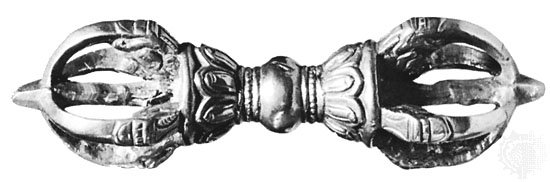
So when we say Vajrasattva, what is meant by that? Vajrasattva is similar to the seven qualities of a vajra, such as being indestructible. Vajra (dorje) here, when we talk about it ordinarily, is like the bone of a great sage, that in his hand, that is made out of the god of the great sage. This is a very extremely powerful weapon that Indra carries in his hand. When Shakra carries this vajra, when pregnant women see demi-gods, they get so frightened that they give birth to their children immediately. In India they talk about the gods and demi-gods, and the demi-gods are depicted as very terrifying. When they see someone has a weapon that has the seven qualities of being indestructible and undefeatable, such as a vajra, made of this great sage.
Sometimes vajra is called like a diamond. The most precious stone is a diamond and it is also the hardest. So it has these different qualities such as indestructibility and so on. These are like a comparison. So when one talks about being indestructible, stable and unobstructable and so on, when they have all these seven qualities, that is a vajra.
The one with the mind (sempa), in Sanskrit ‘Sattva’, means not perishing or deteriorating, they are never discouraged. Because he has both vajra and sattva, we say Vajrasattva. In any case, there are many explanations of the meaning of Vajrasattva but this is the one given in the Indian commentary, so I don’t need to go through them all.
Basically, glorious Vajrasattva means the one glorious being who possesses the vajra and so is the state of Vajradhara himself. So Vajrasattva should be understood as great Vajradhara, reaching the state of great Vajradhara, or Vajrasattva and the one who has his function as the lotus feet of the guru. We are prostrating and serving the guru properly.
Just hearing the word is enough, it is not enough at first we have to listen to these and because of listening to them and practising them properly you will gather the two accumulations and will achieve the state of glorious Vajrasattva, So even though hearing the words does not accomplish our aims, indirectly it can bring us to the glorious state of Vajrasattva. Thus, he says ‘Listen to this with respect.’
In terms of the way of serving/relying on a guru (lama ten-tshul), what is the unmistaken way of serving or relying on the guru? By doing this we are able to gather the two accumulations perfectly and attain the state of Vajrasattva. For this reason, achieving the state of glorious Vajradhara depends upon serving/relying on the guru. In order to rely on the guru properly and unmistakenly we first have to listen to the teachings and we have to listen to them respectfully. We need to make efforts to do this.
The epic Ramayana and the Fifty Verses on the Guru

This text teaches the Fifty Verses on the Guru, and it mentions the story of the Abduction of Sita, which is discussed in the words of the Kadampa forefathers. This is what we normally call the epic of Ramayana, so Sita is the wife of Rama, and the epic describing this is called the Ramayana.
There is the written form of Ramayana and there is also the oral story. So there is the written form and the one that the bards memorised. What is the actual Ramayana? It is neither of these. The actual Ramayana is the abduction of the princess Rama’s wife, by the Devan King Ravana and the great war that they engaged in to protect her. Those events themselves, they are the actual Ramayana, it is the events that happened at the actual time, those were the actual epic. It is OK to say it is just a myth, but in India at this ancient time, you have the epic of the Ramayana, that is taught as actual history and if we think about it in terms of actual history, there is an event that happened historically, an actual event, and that is the actual epic. The one that is written down or the ones the story tellers recite is not the actual epic.
Similarly, when we talk about the Fifty Verses on the Guru, that we have written down in the Tengyur. So if we ask is this the Fifty Verses on the Guru ? It is not the Fifty Verses on the Guru, we can record it these days, is that the actual Fifty Verses on the Guru? If we do a video recording of it and have the images and we ask is this the Fifty Verses of the Guru? It is not, and we can also ask about this. Or there is the understanding of it in our minds. Is that the Fifty Verses on the Guru ? No it is not. So what is it then? It is in order to achieve the unexcelled result, to achieve the state of Vajradhara, we take that aim of achieving Vajradhara and we rely on a guru to achieve that aim, and we follow the gurus as should be done, that is the actual Fifty Verses on the Guru.
When we say the Fifty Verses on the Guru, we say that right? When you are reading a text, we have an understanding of it, the meaning of it, if we don’t put it into practice ourselves, and we just are able to explain the words of the text, but an actual feeling or an actual lifetime, we might not be able to put it into practice. If we don’t make any movement in that direction, then that is not really and understanding. The actual Fifty Verses on the Guru is in order to achieve the unexcelled result, we properly rely on an exulted guru, these are the pith instructions, these are the means and the instructions we need, and for that reason, we should understand the Fifty Verses on the Guru as actually meaning this. So the Kagyu forefathers make the comparison of the Lamp of Enlightenment they use the Ramayana epic. So it is the same here with the Fifty Verses on the Guru.
The meaning of the word ‘guru’ – three reasons for why they are a ‘guru’ and their ‘lotus feet’

After this, how do we understand the meaning of the words, “I bow down to the lotus feet of the guru”? This is connected to bowing down to the feet of the guru, and the guru here means the one who explains the profound secret mantra Dharma practice. Likewise, in terms of the benefit they give us, they are like a father and mother and thus a guru. Also, they are worthy of praise, homage and service, thus they are a guru.
So, according to this Indian commentary, there are three different reasons why we say guru. The first reason is because they give the profound and vast pith instructions. The second is they give us benefit and happiness like our parents, and so they are like a father or a mother. Third, because they are worthy of offerings, worthy of service, and worthy of homage then they are gurus. So these are three reasons why they are guru.
A Guru has these many different qualities, and if you prostrate to their lotus feet, the lotus is a metaphor for feet and you are prostrating to them. When we say ‘prostrate to the lotus feet, just as should be done’, what does that phrase ‘as should be done’ mean? It means the ways to pay respect to the guru that are described in the tantras and the instructions, there are proper ways to do this, so it means in accordance with the proper ways.
For example, before prostrating to the guru you make a mandala offering and supplicate and so on. The proper way of doing it.”Lotus feet”, they are like a lotus flower, this is a praise of the guru, comparing the guru’s feet is a praise. Bowing down is a prostration. So the lines: “Bow down at the lotus feet of the guru.” is teaching three things. There is a prostration of the body, a physical action. The praise of the speech which is verbal. The body and speech are primarily preceded by the mind when they act so for that reason, the sincere and faithful mind is taught, so this is talking about prostrating with the body and speech. In that way we bow down at the lotus feet of the guru.
Two reasons for why Gurus are kinder than Buddhas and Bodhisattvas

At this point, what happens here, according to the Indian commentary, it presents a doubt. Generally, it says when we are talking about the person we are paying homage to, the Buddhas and Bodhisattvas right? Aren’t they the ones we should prostrate to, why are we prostrating to our guru? Why are we calling them our guru? Here it is saying the guru is a special deity and a superior person to prostrate. There are two reasons for this. First, they provide a superior service to us, because they are the natural kaya of all the Buddhas, as it says. These two reasons are given. The second is they act in a superior way towards us, which means that the guru gives an especially great kindness. The gurus and the Buddhas and Bodhisattvas are of course extraordinary, as we always say the guru are the same as them in their qualities, but they are superior in their kindness. the person who is actually giving us guidance is the guru and so they provide us an exceptional service and a great kindness.
The other reason we pay homage is because they are the natural kaya of all the Buddhas, which is as it says in the verse, those who denigrate the guru are denigrating all the Buddhas, which is saying the guru is like an emanation of the Buddhas and someone who performs the activity of all the Buddhas.
To sum up, there is only one job for Buddhas and Bodhisattvas, which is benefiting beings. In order to do that, the sentient beings whom they have karmic connections with and those whom they do not have connections with are various different types of beings. Some of them are appropriate for the Buddhas to tame, some for the Bodhisattvas to tame, some are appropriate for the Pratekya Buddhas/Listeners to tame. Because there are so many different inclinations and abilities of the students. So some beings seem totally ordinary beings and if we follow them and they give us Dharma teachings and we develop longing for liberation, this happens, right? The person who we call the guru is the person who accomplishes the activity of all the Buddhas, who does all of that. That is one way to understand them. All those gurus who take the forms of ordinary individuals are actually doing an incredible kindness. Not only do they have an incredible kindness for us, but ordinary beings are not able to meet the Buddhas and Bodhisattvas in person and get teachings from them. When they meet gurus and masters who take the form of ordinary sentient beings, they can meet them and receive Dharma teachings from them. So for that reason, they are like the representatives of the Buddhas and Bodhisattvas and so they act like ambassadors for them. In this way, the activities of all the Buddhas and the Bodhisattvas, we prostrate to the gurus is a very important point.
It is best to leave it here, if I say too much now I do not know how my body will respond. In any case, I was worried about if I would be able to teach tonight, but I put extra effort in and so I thought if we don’t miss this session and am happy we did not miss it. In general, maybe the way I think about it is, for all of us, when we take these Fifty Verses on the Guru that is related to secret mantra in the past, I have taught a lot of Dharma, but not really connected to the secret mantra Vajrayana but this is Dharma connected to the secret mantra Vajrayana so it is extremely important and significant. The more sacred and significant the Dharma, the more obstacles that occur, so I think it is because of all these different things coming together, it is a relation of cause and effect. As the text is so important and sacred, the teacher needs to be extremely careful about teaching it and the listeners are extremely fortunate and need to think how important and significant this is, and listen with that thought in mind. That is how I thought about teaching this text the Fifty Verses, and I do not know if it will benefit you all, but maybe it would, so I told you.
Endnotes
[1] As an observation [transcriber’s note] this is quite different to how the Indian mahasiddhis practised it though. Great yogis like Tilopa, Naropa and Saraha were all kicked out of the monasteries, or left of their own free will, due to the issues connected with doing secret mantra practice in monasteries, especially with physical consorts. I recently spoke about the monastic takeover of Vajrayana/Secret Mantra in Bhutan and how it does not seem to be consistent at all with the female and layperson roots of secret mantra union practice, and what Atisha taught about monastics not being able to take the second and third empowerments. One might wonder (as I did), why don’t those monks just leave the monasteries and make it easier on themselves (and everyone else) by practising unions away from monks and nuns? It’s a question it would be good to know how the 17th Karmapa would answer it.
[2] On a translation note, I noticed that the oral translator Khenpo Karma David Chophel translates the Tibetan phrase ‘ten-tsul’ as ‘following a guru’. However, this is not quite correct in terms of the etymology of the word, which has a sense of ‘relying on’ or ‘serving’ the guru’. Overall, the oral translation is excellent but (when I have time and opportunity) I am going back into the original Tibetan to ensure the transcript is as accurate as possible.