
“This treasure text (ter-sho) of Pema Vajra meditation is from the first Mingyur Rinpoche who revealed this text from a rock in Tibet. That is what we call a treasure sadhana. More than one thousand years before, Guru Rinpoche came to Tibet and taught this sadhana, the Pema Vajra practice in Tibet but during those days, good golden days, Guru Rinpoche said there’s plenty of practices now and we don’t need to continue to practice Pema Vajra at that time. But in the future, during the degenerate time, this practice is very important.” –Mingyur Rinpoche (2020)
For Dakini Day today, and the 49-day period of the passing of HE 9th Khenchen Thrangu Rinpoche, I offer this short post related to the recent announcement by Thrangu Tashi Yangtse monastery that as per the instruction of HH 17th Gyalwang Karmapa for the sixth week of the 49-day rituals they have begun a weeklong practice of “Pema Vajra” at Namo Buddha. The announcement stated that:
“Pema Vajra” is a Terma discovered by the first Yongey Mingyur Dorjee; it belongs to the Three Canons of Yongey, with the other two being “Tsedrub Thabshey Khajor (Long Life Sadhana of the Union and Method)” and “Guru Drolod (the wrathful practice of Guru Rinpoche)”.
Here is my short overview of this terma and its practice, with a transcript of the current Yongey Mingyur Rinpoche’s description of the practice and its seven mandalas here on Youtube in 2020. He explains that the treasure text was composed by Guru Padamsambhava and written in dakini script and hidden in rock by Yeshe Tsogyel and that Padamsambhava had predicted it would be especially useful of degenerate time like now. The ‘age of gross conceptuality’. Rinpoche advises that one can also recite the Pema Vajra mantra, Om Pema Vajra Hum if one wishes.
Music? Yeshe Tsogyel mantra Om Ah Hum Vajra Guru Jnanasagara Bam Ha Ri Ni Sa Siddhi Hum and for the degenerate era, Sign O’ the Times by Prince.
May Thrangu Rinpoche have a swift re-birth and may the treasures of Yongey Mingyur Rinpoche flourish and prosper!
Compiled and transcribed by Adele Tomlin, 12th July 2023.
Treasure-Revealer Yongey Mingyur Dorje (1628-1708)

Yongey Mingyur Dorje (ཡོངས་དགེ་མི་འགྱུར་རྡོ་རྗེ་) (1628/41-1708), aka Rigdzin Mingyur Dorje Drakpo Nuden Tsal — was a Nyingma terton (one of the twenty-one major tertons with the name Nuden) and Karma Kagyu master who was a close student of Karma Chakmey, the Tenth Karmapa Choying Dorje, and Zurmang Trungpa Kunga Namgyal (zur mang drung pa kun dga’ rnam rgyal), the Fourth Zurmang Trungpa. His most illustrious students included the Eleventh Karmapa, Yeshe Dorje, the Eighth Tai Situ, Kunkhyen Chokyi Jungney, and Terton Konchok Dorje.
The first Yongey Mingyur Dorje is also the founder of the Pal Tergar Rigzin Khacho Dargye Ling Monastery, which was established as a center for the teachings that he revealed. In the centuries that followed, this monastery retained its affiliation with the Karma Kagyu School, yet also kept up its own unique practices and rituals. After the Cultural Revolution, it was rebuilt both in Tibet and in Bodhgaya, India by the current Yongey Mingyur Rinpoche.
For more on Yongey Mingyur Dorje and his other famous treasure revelation on the 2nd Karmapa, Karma Pakshi Guru Yoga sadhana, see my article here.
The Seven Mandalas of Pema Vajra

Thrangu Monastery also stated that:
“In the main shrine hall of Thrangu Monastery, a 4 tiered mandala was built. At the middle of the top tier is a red torma representing the yidam deity; tormas in four directions representing the activities of peace, increase, power, wrath; five protector tormas; two vases. The tier below it has 108 tormas and 108 sets of menrak. On the third tier are offerings including 108 shalze tormas, flowers and incense, and there are 108 tsok offerings on the lowest tier. There is also a set of eight offerings placed before the mandala.”
This seven mandala of Pema Vajra was briefly explained in a short online teaching given on it by the current Mingyur Rinpoche last year, see video and transcript below. He explained how each of the mandalas represent:
“The mandala of activities, mandala of qualities, mandala of mind, mandala of speech, mandala of body. So, five main mandalas. Then, there’s another true mandala, what we call mandala of the bindu, meaning the mandala of light. Another is the mandala of hand object, I will say the weapon of compassion held in the hand. So, there are seven mandalas.”

Tibetan Textual Sources
I looked online for Tibetan source texts on this practice and found this one reproduced in 1982 from a manuscript used by the Um-zey (chant master) of Rumtek monastery in Sikkim [1]:


Transcript of HE Mingyur Rinpoche’s teaching (2020)

“So now we are having a Pema Vajra group practice together. Pema Vajra is the Guru Rinpoche manifestation of what we call nirmanakaya. Normally, we talk about three kayas, the dharmakaya which is beyond concept, no form, no color, no shape. Then the second kaya is the sambhogakaya manifest as a form, but a form which is beyond time and the matter. Just like a moon reflection in the lake, or your own reflection in the mirror. Your reflection in the mirror looks like there’s a very clear image, but at the same time it is beyond matter. So it is beyond time and matter but the form can manifest in different ways, like rainbows in the sky. So that is what we call the nirmanakaya form, and that form is beyond death and dying, because it’s unborn it is not going to die. That is the basis of what we call all phenomena. Actually, the base of our own body, base of whatever we see, is this luminous form but we have not recognized that and what happened for us, is we are grasping it. So now what we perceive is solid this body, our own body being born, getting old, sick and dying. The sambhogakaya form is Pema Vajra. The nirmanakaya form of Guru Rinpoche came into the impure world like us, like Buddha Shakyamuni being born, getting old, dying. So this is what we call the nirmanakaya, which could be anything of various forms. So now we are practicing here Pema Vajra who is the Guru Rinpoche, Sambhogakaya form.
This treasure text (ter-sho) of Pema Vajra meditation is from the first Mingyur Rinpoche who revealed this text from a rock in Tibet. That is what we call a treasure sadhana. More than one thousand years before, Guru Rinpoche came to Tibet and taught this sadhana, the Pema Vajra practice in Tibet but during those days, good golden days, Guru Rinpoche said there’s plenty of practices now and we don’t need to continue to practice Pema Vajra at that time. But in the future, during the degenerate time, this practice is very important.

Then, Guru Rinpoche asked Yeshe Tsogyel to put the Treasure text (Tersho) in the rocks. She wrote down the dakini letters and put it into the tube, and sealed it into the rocks. [For more on dakini script, see my article here. For more on Yeshe Tsogyel see here. ]
Then, for about seven to eight hundred years, this practice was no longer in the world, it is sealed. They first discovered this practice and it is specially for the degenerate time. This means that right now we have a lot of conceptual, gross conceptual thoughts, the age of the concept. A lot of clashes negative emotion, a lot of mental suffering, negative emotions, a lot of various sufferings of mind, body, and environmental obstacles will happen now in this degenerate time. So, the Pema Vajra practice is esspecially for this degenerate time. We are practicing it here for a few days in the Dekyi Oseling monastery in Nepal and this is the first time here in Kathmandu we are doing this big prayer.
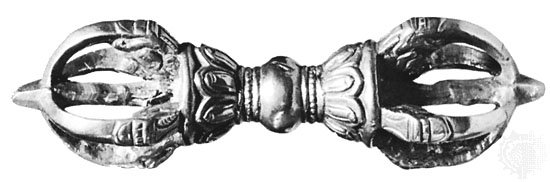
In this Pema Vajra sadhana there are what we call the seven mandalas. The mandala of activities, mandala of qualities, mandala of mind, mandala of speech, mandala of body. So, five main mandalas. Then, there’s another true mandala, what we call mandala of the bindu, meaning the mandala of light. Another is the mandala of hand object, I will say the weapon of compassion held in the hand. So, there are seven mandalas.
So how do we practice this? There are two visualizations, the front visualization here and the self-visualization, where you imagine yourself. So for the self visualization: at the forehead, throat, heart center, navel, secret place, within these five places, we imagine five mandalas and then the light is radiating around you. And also the hand object also radiates with your hands and from the different aspects of the body. The purpose is to transform yourself, the five kleshas, five elements, five skandhas. So these are transformations in this five mandala and then to help to all beings. So we imagine the environment as Buddha pure realm and in the end all beings become Pema Vajra, so this is the self visualisation.
The front visualization is symbolic of that, there are seven mandalas here. So I will introduce you to them. Now the first here is the torma and beneath this torma there’s a symbol of the Pema Vajra mandala. So this is the first mandala of activities. Then there’s a bumpa (vase) and this is what we call the mandala of qualities. Then we have Kapala (skullcup) and this is what we call mandala of mind. Then above that there are three mandalas. So the symbol here, the mandala of speech, is the mandala of all of the mantra and the letters. Then mandala of body and then above that is the mandala of light. And this all this mandala of the body kind of like a lot of images of the buddhas. Then each Buddha has in their hands objects, the mandala of activities. So there are so many different mandalas and all these total seven mandalas.
I think if you want to participate from far away with this practice you can also recite the simple mantra: OM PEMA VAJRA HUM. You can recite this time to time so there’s no particular hour or time so whenever you feel that you’re part of this practice, even though you’re not here, it’s okay the intention is important. So we all practice here in the Oseling monastery but you can you just feel that you’re part of this practice, and that you are like the Pema Vajra and you can pray to Pema Vajra and recite OM PEMA VAJRA HUM.”
Endnotes
[1] Yongs dge gter ston mi ʼgyur rdo rje. Tshe sgrub thabs shes kha sbyor gyi dkyil ʼkhor dang padma badzra grub thob rgya mtshoʼi dkyil ʼkhor gyi bcaʼ thabs dang ʼdon sgrig sogs kyi phyag len zin deb. Karmapae Chodhey, 1982. Buddhist Digital Resource Center (BDRC), purl.bdrc.io/resource/W1KG12794.
There’s no link to the 2022 YouTube page and I couldn’t find it on YouTube. Love your offerings. Best, Virginia Harris
On Tue, 11 July 2023, 8:10 am Dakini Translations and Publications
Thank you but I have checked the link and it is there and working.